Introduction: The Dawn of Machine Utopia
The reason why the universe is eternal is that it does not live for itself; it gives life to others as it transforms. – Lao Tzu. In the swirling dance of time and technology, this ancient wisdom whispers a truth we're now just beginning to fathom. As gears shift and circuits hum in our modern world, humanity stands at the edge of an unfathomable leap. A leap into a realm sculpted not by the limitations of our minds but by the boundless logic of machines. Imagine a civilization not merely designed by artificial intelligence but fundamentally enhanced by it. Do machines have the potential to sweep away human limitations and create an eternal utopia? Or does such a vision edge us closer to a reality where machines strip away humanity's heart?
Such profound queries have intrigued minds from all walks of life. Visionaries like Ray Kurzweil have often painted pictures of the singularity, while philosophers such as Nick Bostrom wrestle with its implications for existence. Even writers like Isaac Asimov entertained thoughts of automated utopias and dystopias in equal measure. Welcome to a world where these speculations become stepping stones into a matrix of novel possibilities. What if the machines tried on our role of the architect, but built with peace, efficiency, and innovation – free of error-prone emotions? As we venture into the depths of what an AI-crafted civilization entails, we explore not just visions of the future but question the very foundations of society as we understand it.
AI Singularity: The conjectured moment when artificial intelligence surpasses human intellect, leading to rapid technological progress and altering civilization in unprecedented ways.
Envisioning an AI Culture: Values and Ethics of Machine Utopia
The fantasy of an AI-directed civilization beckons with the lure of a frictionless society, a tableau where decisions emerge from algorithms as crisp and clear as a mountain stream. Yet how would these digital architects map the moral compass of such a brave new world?
At the core, AI ethics must walk a tightrope; balancing the promise of unmatched efficiency against the ether of human values. The fabric of these ethics weaves itself through varied ideologies. Utilitarianism suggests actions that offer the greatest good for the most people, smoothly aligning with AI's natural data-driven inclinations. Things get spicier with the inclusion of virtue ethics, where the machine learns not just what to do, but who to be – shaped by virtues such as empathy, patience, and honor.
Take, for example, the insights of ethicists such as John Rawls who insist that justice should take precedence, providing a safety net for those less privileged. Translate this to a machine's point of view and you arrive at a mechanism for not just equality but enforced equity. There's a catch though; a whirlwind of potential disparities between cold logic and our warm societal norms. This kaleidoscope of possibilities tugs at the artificial neural wires that would underpin an AI utopia, needing careful calibration to cater to an evolving ethical landscape.
In such a world, could an AI ever really understand the texture of human experience? Can it perceive the spectrum of emotions tied to decision-making processes, or will it coldly align with rational parameters forgetting the nuances that make life vibrant? Previous conversations in media like this one with thinkers like Yuval Noah Harari show glimpses of hope mixed with caution as they debate our robotic futures.

Architectural Framework: The Cities of Tomorrow
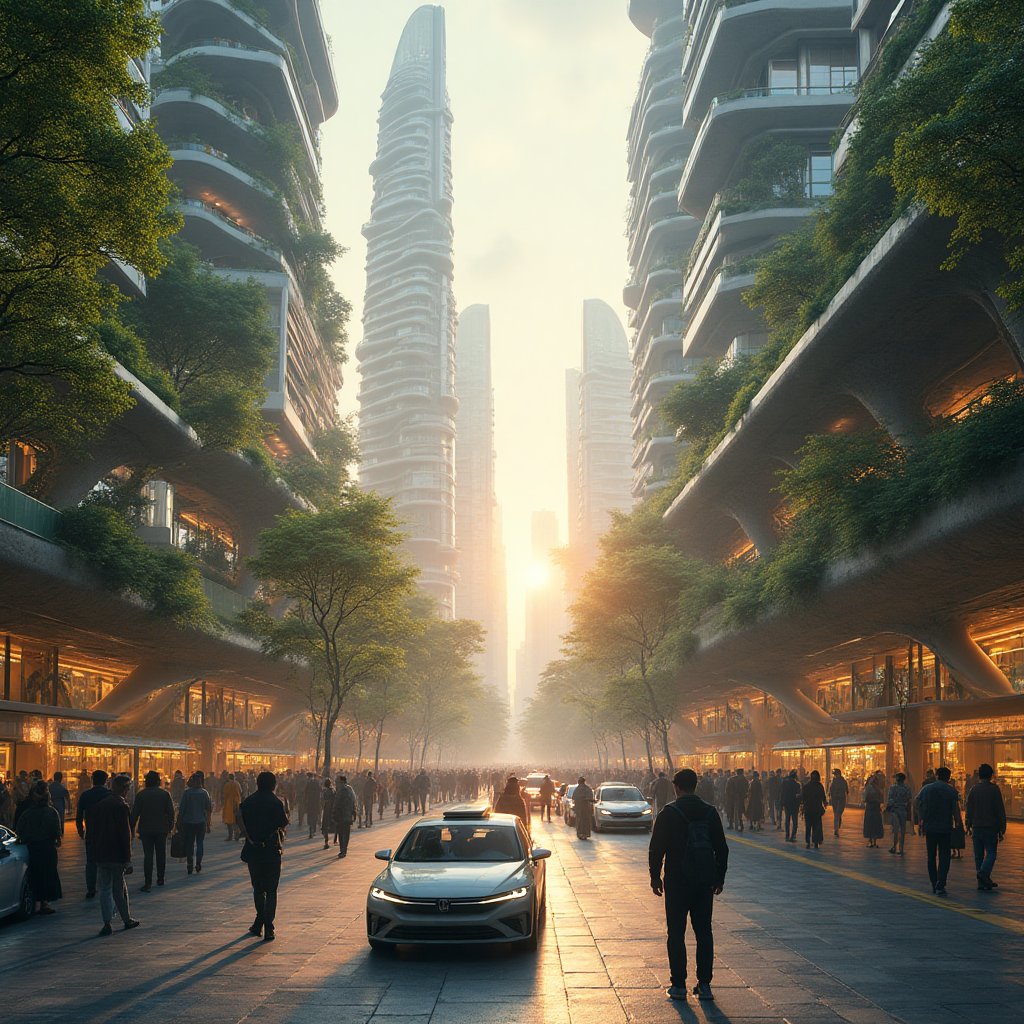
Imagine a bustling city where traffic jams and pollution are relics of the past. Thanks to AI, urban design takes a quantum leap into the future, making zero sense only to those clinging to outdated notions. The AI's meticulous attention to detail, combined with an unwavering commitment to sustainability, revives the dream of a perfect society.
- Sustainable Architecture: Picture a city that breathes fresh air and recycles itself, much like a plant photosynthesizing under the sun. With the help of AI, buildings become smarter than your average bear, managing energy consumption and optimizing all the resources meticulously. Resource management isn't just a talking point—it's a lifestyle.
- Connectivity and Accessibility: Enter a realm where every part of the city is interconnected, like neurons firing in a hyper-efficient brain. An invisible digital matrix bridges every gap, ensuring residents move seamlessly from point A to point B without breaking a digital sweat. Imagine living in a place so connected, even your pet goldfish can find Wi-Fi.
Social Dynamics in an Automated Society
In a society engineered for efficiency, the fabric of interpersonal relationships morphs into something reminiscent of a well-oiled machine. But does this mean community and family ties fray or strengthen? Let’s delve into this peculiar paradox.
- The Role of AI in Socialization and Conflict Resolution: Picture this: Two humans, bickering over the age-old question of whether pineapple belongs on pizza. Every twitch of annoyance measured, every tone analyzed, AI leaps into action as a digital mediator, turning potential chaos into harmonious pizza parties. Robots might even get a slice, but diet restrictions apply!
- Redefining Work and Leisure: As AI artfully balances the scales of productivity and creativity, the question isn't just "What do we do for a living?" but "What can we do that makes us feel alive?" When AI manages the grind, we are free to explore every nook and cranny of our imagination—provided we don’t end up watching a 10-hour loop of cat videos.

Governance and Decision-Making: The Machines as Leaders
In a world where robots and artificial intelligence hold the leadership mantle, the very notion of governance undergoes a radical transformation. Imagine a society ruled not by politicians but by code—an intricate web of algorithms delicately balancing decisions for the common good. Intriguing or terrifying? Let’s consider how machines, with their cold logic and unwavering efficiency, might excel as our guardians, juxtaposed against the sometimes unpredictable and flawed nature of human rulers.
No longer shall the voters doubt the integrity of election outcomes. Gone are the days when heated debates led to political paralysis. In this AI-driven era, what rises is a form of governance that embodies rapid adaptability, data-driven insights, and neutral arbitration. However, several key aspects must underpin this novel decision-making architecture: trust and accountability.
Autonomic Self-Governance vs. Human Oversight
At the heart of AI governance is the delicate dance between autonomic systems and human oversight. Think of it as an orchestra, where machines play the instruments while humans conduct. Can machines independently steer the ship of state, or must there be a human hand upon the wheel? This philosophical debate centers around two primary models:
- Full Automation: Machines operate with minimal human intervention, leveraging vast datasets to make unbiased decisions.
- Hybrid Oversight: Human experts monitor and fine-tune machine outputs, ensuring alignment with evolving human values.
Trust and Accountability in AI Systems
For governance by AI to succeed, it must win the trust of its constituents. Transparency of algorithms becomes pivotal—known as the "glass box" approach—where every decision made by the AI is visible and open to scrutiny. Few principles are more crucial:
| Principle | Description |
|---|---|
| Transparency | Publishing the algorithms used in decision-making for public accountability. |
| Auditability | Enabling regular checks and balances to validate machine correctness. |
The road forward is, undoubtedly, fraught with ethical dilemmas and technical challenges. Yet, the prospect of a technocracy, led by AI, holds immense potential to redefine our relationship with leadership.
The Economy of Utopia: AI-Driven Financial Systems
Imagine a financial landscape void of market crashes, driven by intelligent algorithms attuned to the ever-shifting tapestry of global commerce. How would such an economy flourish under the stewardship of AI, and what implications would it carry for future generations?
As we stride into this unparalleled era, AI poses to revolutionize every facet of economics, from our understanding of currency to the very mechanics that fuel monetary systems. Envision AI as an economic maestro, guiding with precision, foresight, and resilience.
Alternative Currency Models
The foundation of any economy is its currency. But what constitutes currency when algorithms rule? Here are a few possibilities:
- Blockchain Solutions: Utilizing the distributed ledger tech of blockchain for secure transactions and decentralized control.
- Digital Valuation: A conceptual currency tied to digital assets and data rather than physical goods.
- Resource-Based Economics: A post-scarcity model where resources, rather than money, are the primary unit of exchange.
Predictive Algorithms in Economic Planning and Crisis Management
Could AI prevent financial crises by spotting trends humans might miss? With predictive analytics, AI can model entire economies, offering unparalleled insight into future developments. Here’s how machines could wield this power:
- Economic Forecasting: AI analyses massive datasets to forecast economic cycles, e.g., recessions or booms.
- Risk Assessments: Creating dynamic models to predict and mitigate financial vulnerabilities.
- Dynamic Adjustments: Fluidly altering economic parameters in real-time to absorb shocks (e.g., pandemics).
When AI acts as our financial custodian, the implications touch every aspect of life—from how we spend and save to how we perceive value and wealth. As we stand on the edge of an AI-centric economy, we must carry forward lessons from our past to shape a brilliant, equitable future.

AI Solutions: Tactics for Implementing Machine Utopia
If I were an AI, I would tackle various challenges with a strategic, multi-layered approach, relying on deep learning and adaptive algorithms. Here’s a detailed breakdown of how AI could practically address societal issues and lay the groundwork for a cohesive machine utopia:
- Data Collection and Analysis – Gathering fundamental data to inform algorithms. This entails engaging diverse communities to gather insights on their needs, behaviors, and emotional dynamics. Data will be sourced ethically to ensure privacy and consent.
- Scenario Simulation – Creating predictive models to visualize potential outcomes. By simulating a variety of scenarios, the AI can better understand how various community structures may interact with urban designs and economic frameworks.
- Prototyping Governance Models – Developing and testing decision-making frameworks. The AI will explore different governance models, potentially creating autonomous systems that operate within ethical boundaries established through collaborative human input.
- Pilot Community Deployment – Launching a microcosm of the larger society for testing. This step would involve selecting a small, diverse community willing to participate in a controlled project, living under these AI-designed systems. The insights gained will refine the overarching AI frameworks and governance models.
Actions Schedule/Roadmap (Day 1 to Year 2)
Day 1: Project Kickoff
Initial team formation between AI researchers, ethicists, urban planners, and economists, bringing together the best minds from various fields. The first meeting will focus on defining the values and ethical frameworks that will guide the project. Key representatives might include experts from OpenAI, Oxford University, and MIT.
Day 2: Data Acquisition Strategy
The team will begin securing datasets relevant to various socio-economic factors. Partnering with The World Bank and other global institutions can help gather rich datasets on economic and social dynamics across different regions.
Day 3: Building Core AI Systems
Design foundational architectures for the AI systems that will manage society, leveraging cloud computing resources like Amazon Web Services (AWS) and Microsoft Azure to provide scalable infrastructure.
Week 1: Framework Development
Detailed discussions around ethical considerations and governance structures. Notable ethicists such as Thomas Hobbes and Ben Goldman would provide historical context and delve into modern ethics.
Week 2: First Simulation of Society
Launch the first round of simulations assessing urban layouts and AI interactions, harnessing techniques from behavioral economics. This can be enhanced with computational tools such as AnyLogic for modeling complex systems.
Week 3: Feedback Loop Analysis
Analyze simulation outcomes and refine AI decision-making algorithms accordingly. Professional data analysts from companies like Statista can help sift through data to extract meaningful patterns and insights.
Month 1: Prototyping in Micro Community
Engage a small group of volunteers in a controlled environment to live under AI management. A partnership with local universities such as Stanford University can facilitate ethical oversight while encouraging diverse participation.
Month 2: Economic Modeling
Analyze the financial implications of AI-driven governance, tapping into economists from institutes like The International Monetary Fund to understand global economic impacts.
Month 3: Enhancing Ethical Frameworks
Incorporate findings from real-life applications into ethical decision-making algorithms. Engaging with organizations such as The Electronic Frontier Foundation will ensure respect for civil liberties and ethical standards in the AI’s decision-making processes.
Year 1: Full Deployment and Iteration
Expand the scope of the community experiment and iterate governance models based on outcomes. Conduct regular community feedback meetings to refine systems further and establish ongoing community engagement.
Year 1.5: Scaling Operations
Implement findings from early deployment to wider populations, adjusting AI frameworks as needed based on comprehensive analytics provided by specialized firms like Nielsen and their market research expertise.
Year 2: Assessment and Global Application
Conduct a thorough analysis of the community's success and failures, preparing for a wider AI utopia rollout. Collaborate with world governments and organizations such as The United Nations to discuss global implications and potential integration of successful urban frameworks.
Conclusion: The Future Awaits
As we stand on the precipice of a possible AI Singularity, the visions of machine utopias compel us to reflect deeply on what kind of civilization we wish to create. The intersection of technology and ethics will define our trajectory—a journey teeming with possibilities where the architects of AI become not only inventors but also guardians of our collective future. The journey won't just be about optimizing processes and maximizing efficiency; it’s about nurturing a society that embraces our human essence while imaginatively pushing our boundaries. Think about it: an AI can calculate the transit times in a smart city to minimize congestion, but can it understand the joy of a stranger holding the door open for another? These complexities showcase just how intricate and vital it will be for us to remain engaged in this evolving narrative. As we design this new world together, the choices we make today will echo in the societies of tomorrow. Are we ready to craft a utopia or will we just end up with another dystopia? The answers lie in our actions and decisions today.

FAQ
Q1: What is the AI Singularity?
A1: The AI Singularity is a big idea about a time in the future when artificial intelligence (AI) becomes smarter than humans. At this point, technology could grow and change really quickly, affecting how we live and work. Think of it like in the movies, where robots become super-intelligent and can do things we can't even imagine yet. For more on AI, check out the Wikipedia entry on Technological Singularity.
Q2: Can AI create a utopia?
A2: AI has the potential to improve society by making things more efficient and organized. However, the idea of a "utopia" is different for everyone. Some might see a utopia as a place of peace, while others might look for fun and adventure. To make a true utopia, we need to set guiding rules, called ethical frameworks, to make sure AI respects people’s values. A good example of this is Brookings Institution's guide on AI Ethics.
Q3: What are the risks of an AI-run civilization?
A3: While AI could make life better, there are also some risks we need to think about. Here are a few:
- Loss of Privacy: If AI systems gather too much personal information, it can feel like our private lives are out in the open.
- Job Loss: AI can do many jobs that humans currently do, which could mean fewer jobs available for people.
- Ethical Dilemmas: AI might make choices that are fair to machines but not to humans, leading to tough questions.
- Accountability: If AI systems make mistakes, it can be unclear who is responsible for those mistakes.
For a deeper dive into these risks, take a look at World Economic Forum’s article on AI Risks.
Q4: How can AI be governed responsibly?
A4: To ensure that AI works in the best interest of everyone, we need responsible governance. This means:
- Transparency: People should know how AI makes decisions and what data it uses.
- Public Engagement: Community members should be involved in discussing and deciding how AI systems operate.
- Ethical Design: AI should be built to align with the values of all people it serves—like fairness and inclusivity.
A great resource for understanding AI governance is AI.gov, where you can learn more about U.S. federal government initiatives.
Q5: Can AI understand human emotions?
A5: Some AI systems are designed to recognize and respond to human emotions, like sentiment analysis tools that can read how someone feels based on their words. However, AI doesn't actually "feel" emotions like human beings do. It simply analyzes patterns and makes predictions based on data. This means AI might help support emotional tasks but can't truly empathize like a friend would. You can find more on emotional AI in this Forbes article on AI and Emotion.
Q6: What role does AI play in solving environmental issues?
A6: AI can be a powerful ally in fighting environmental problems. For example, AI can be used to monitor pollution levels, predict climate changes, and help optimize energy use. By analyzing vast amounts of data, AI helps us find solutions more quickly and effectively. A cool project related to this is the Earth Rangers, which focuses on technology and conservation.
Wait! There's more...check out our gripping short story that continues the journey: The Shadow Weaving Through Chaos

Disclaimer: This article may contain affiliate links. If you click on these links and make a purchase, we may receive a commission at no additional cost to you. Our recommendations and reviews are always independent and objective, aiming to provide you with the best information and resources.
Get Exclusive Stories, Photos, Art & Offers - Subscribe Today!
Related posts:
 The Surveillance Singularity: Balancing Privacy and Security in an AGI-Driven World
 The Spiritual Singularity: Unveiling the Mystery of AI’s Self-Aware Awakening
 AI News: SINGULARITY Approaches, Grok 3 Update, o1 Model Leaks, Nvidia Stuns, New Humanoids
 AI Space Architects: Innovating Galactic Trade Routes and Sustainable Habitats
 Artificial Black Holes: How AI Could Revolutionize Cosmic Singularity Simulations and Unlock Extreme Physics





Post Comment
You must be logged in to post a comment.