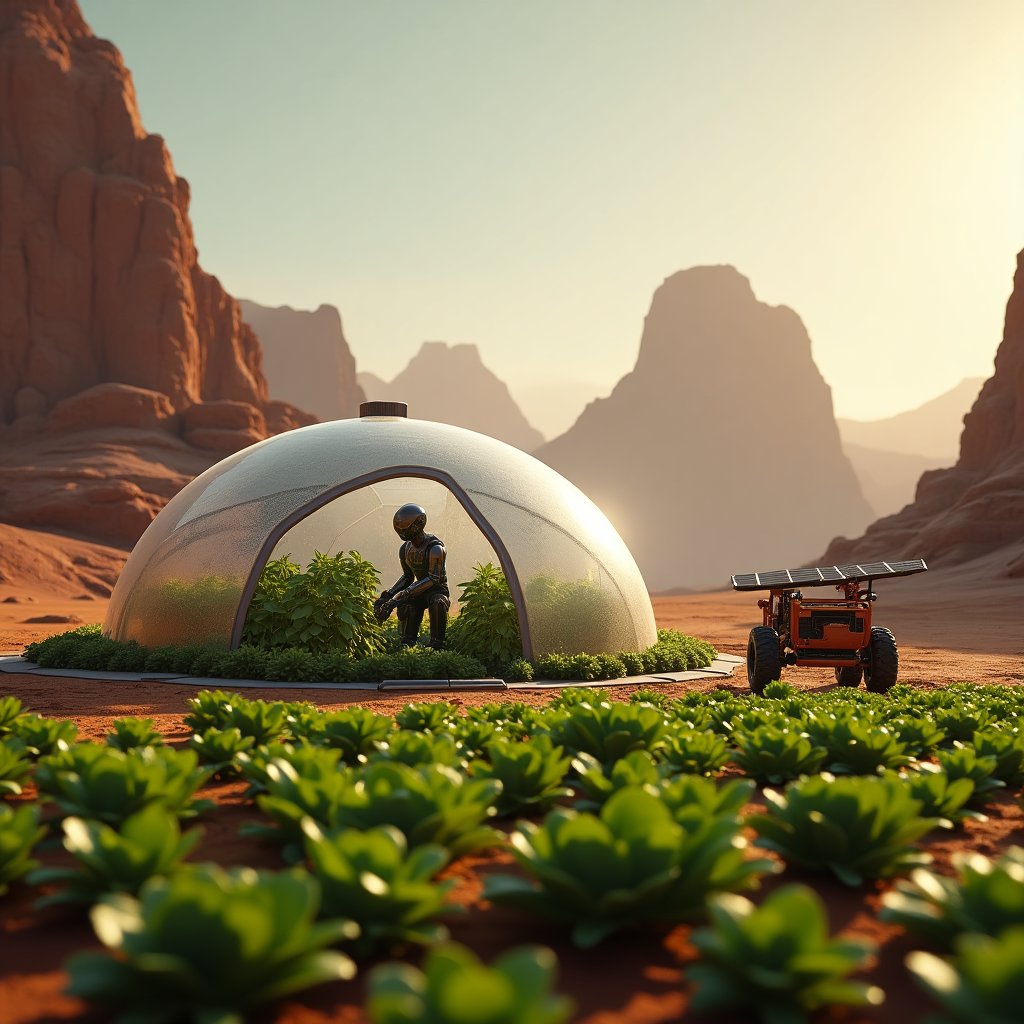
Introduction: The Future of Agriculture Beyond Earth
To crush your enemies, see them driven before you, and to hear the lamentations of their women! —Conan the Barbarian.
While Conan may not be the first person you'd expect to reference Martian agriculture, let's dig a little deeper. This famous line reminds us of the relentless pursuit for victory, even in the most unlikely scenarios. Just like Conan battled for supremacy in a fictional universe, humanity is now battling against harsh Martian conditions to carve out a future for ourselves there. We may not face swords and sorcery, but our struggle for survival on Mars hinges on finding ways to cultivate food on a barren land. Can we harness the power of AI and robotic technology to turn this wild dream into a sustainable reality? The clock is ticking, and the red planet waits for no one!
The challenge of developing a self-sustaining agricultural system on Mars is daunting. Yet, it’s also thrilling! Renowned figures like author and futurist Catherine Mohr, planetary scientist Cynthia Phillips, and astrophysicist Neil deGrasse Tyson have touched upon the synergies between agriculture and technology in their compelling works. They challenge us to think outside the box. So, can autonomous Robo-farmers really thrive on Martian soil? Let’s delve into this technological wonderland!
AI, or Artificial Intelligence, involves the simulation of human intelligence in machines designed to think and learn like humans. When applied to agriculture, it has the potential to revolutionize how we grow food by utilizing data-driven decision-making, enhancing crop yields, and automating mundane tasks—skills that will be essential in developing sustainable agricultural systems on Mars.
1. Understanding Martian Conditions: The Landscape of Challenge
To tackle the issue of sustainable agriculture on Mars, we must start with a thorough understanding of the planet's features. Unlike Earth, Mars has low temperatures, high radiation, and a thin atmosphere composed mainly of carbon dioxide.
1.1 The Martian Climate and Soil Composition
The average temperature on Mars hovers around -80 degrees Fahrenheit. Think about that for a second—a frozen tundra where your favorite ice cream might actually thrive! However, the soil, although rich in minerals, is about as welcoming as a cactus at a pool party—lacking in the organic material found in Earth’s fertile lands.
1.2 Water Resources and Challenges
Water is paramount to farming. While Mars might not have the best water park, it does hold ice beneath its surface, and we cannot forget those tricky dust storms that whip across the landscape. But fear not! Techniques to extract and purify water could save the day! Hydroponic farming could be our knight in shining armor, as it doesn’t even require soil! Just think, fresh tomatoes on Mars, all thanks to AI and robots—make room for your salad! What a world we are stepping into!

2. The Role of AI in Agriculture: Present and Future
Artificial Intelligence is not just for robots in movies; it's transforming the way we farm here on Earth and could do the same on Mars! From predicting crop yields to optimizing the use of water, AI is already proving its worth. But can it adapt to extraterrestrial challenges? Let’s dive into some of these Earthly advancements and see how we might use them for Martian agriculture.
2.1 Lessons from Earth-Based AI Agriculture
Farmers around the globe are now using AI technologies to solve everyday challenges. For instance, precision agriculture—using drones and sensors—allows farmers to monitor their fields closely. These magical machines can tell you exactly where your crops need water or nutrients. According to NCBI, precision farming can increase yield by up to 20%! That's a good reason for farmer Joe to trade in his pitchfork for a tablet!
2.2 Adapting Earth Techniques for Mars
Now, the fun part is figuring out how we can take these nifty Earth technologies and adapt them to the Red Planet. With Mars being so cold (think ice cream cone in a freezer), the techniques used in warmer climates won’t work as well. For example, we could use indoor farming methods combined with hydroponics—growing plants in water instead of soil. Imagine a greenhouse controlled by a computer adjusting temperatures and light levels as if it were running an elite spaceship! That's the future we're aiming for!
3. Robotic Innovations: The Engineering Behind Robo-Farmers
When we say "Robo-farmers," we’re not talking about the robots from Transformers who want to take over the world! We’re discussing real, working robots designed to help us grow food on Mars. So, what kind of robotic innovations do we need? Buckle up; it’s going to be a wild ride through the world of futuristic farming machines!
3.1 Autonomous Systems for Farming Tasks
We're not just dreaming here; we need specific kinds of robots that can handle everyday farming tasks on Mars! Think of autonomous rovers that can assess soil conditions, plant seeds, and even water plants all by themselves. Imagine a little robot saying, "Hey, it's time to water the crops!" while you're sipping coffee on your Martian patio. Wouldn’t that be lovely? These robots need to be super smart and adaptable, probably using AI to make decisions on the fly, much like how we use Boston Dynamics robots to navigate tough terrains on Earth!
3.2 Power Sources for Martian Robots
One of the significant challenges for these robots is finding a reliable power source. Solar energy is a great option, especially since Mars gets more sunlight than you might think. A study by ScienceDirect shows solar panels could provide enough energy to keep our Robo-farmers buzzing. However, on cloudy days (yes, Mars has those too), we might look into nuclear options for energy. They say, “The more, the merrier,” but in this case, “the more energy, the merrier!”

4. Sustainable Practices: Ecosystem Engineering on Mars
Creating a sustainable agricultural system on Mars is not just about growing crops; it’s about developing a balanced ecosystem that mimics Earth's natural processes. This effort is crucial, as it's nearly impossible to simply transplant Earth-based methods to the Martian environment. It requires innovative thinking and technologies, working together to form a harmonious relationship with this new land.
4.1 Soil Fertility and Growth Techniques
For farming on Mars to be successful, the barren soil needs a significant boost in quality. Here are some techniques that may help enhance soil fertility:
- Biomanagement: This involves adding organic matter and beneficial microorganisms to the Martian soil. In principle, compost and biochar could be treated to create an Earth-like environment where plants could flourish.
- Genetically Modified Organisms (GMOs): Scientists could develop crops engineered to thrive in harsh conditions, using fewer nutrients and water. For example, researchers at UC Davis are exploring genes that could provide additional resistance to extreme environments.
- Hydroponics: Growing plants in a water-based nutrient solution might help bypass the poor soil quality on Mars entirely. Research from companies like AeroFarms shows that hydroponic systems are revolutionizing food production on Earth by maximizing space and minimizing water usage.
4.2 Circular Economy in Martian Agriculture
A sustainable agricultural operation needs to minimize waste while optimizing resource use. The concept of a circular economy can be an effective framework for Martian farming.
The idea is simple: waste from one part of the system should serve as a resource for another. This not only reduces the amount of waste but also helps establish a self-sustaining ecosystem. Key strategies include:
- Resource Recycling: Techniques such as worm composting could be used to break down organic waste generated by human settlers, transforming it into nutrient-rich fertilizer.
- Closed-Loop Systems: Using recycled water from plant growth processes to irrigate new crops. Plants like rosaceae have shown excellent capabilities for nutrient recovery, contributing to soil fertility.
- Integrated Pest Management (IPM): Employing natural predators could keep pest populations in check. Research from the USDA shows that beneficial insects can reduce pesticide usage significantly.
5. Ethical and Social Considerations of Martian Agriculture
As we embark on the adventure of terraforming Mars to support human life, it’s essential to pause and consider the ethical implications of creating a new agricultural system. The decisions we make today will shape not just our new life on Mars but also our responsibilities to future generations.
5.1 Ethical Use of AI in Agriculture
The integration of AI in agriculture comes with its own set of ethical concerns. While AI can enhance productivity and efficiency, it also poses questions about accountability and the future of work. Considerations include:
- Job Displacement: Traditional farming roles may diminish as robots take over labor-intensive tasks. Considering the need for human oversight, how can we balance these changes positively?
- Accountability: If an AI system makes a wrong decision, who is responsible? This question is particularly pertinent when it involves food supplies for future settlers.
- Transparency: Ensuring that AI systems operate transparently helps foster trust among Martian inhabitants. Ensuring community engagement in technology development can help.
5.2 Involving Future Martian Settlers
It’s crucial to think about who will inhabit Mars and how these future settlers will engage with the agricultural practices that support them. Here are some key points to consider:
- Education: Teaching settlers about sustainable practices and technology will empower them to make informed decisions about their agricultural future.
- Community Engagement: Involving settlers in the planning and operation of agricultural systems fosters a sense of ownership and responsibility, making the success of Martian agriculture a collective goal.
- Preserving Cultural Heritage: Learning from Earth's diverse agricultural practices can shape Martian strategies. Connecting future settlers with their Earthly traditions might inspire innovative farming methods.
As we march forward to plant the seeds of a new civilization on Mars, our choices regarding technology, ethics, and community involvement will determine how bright our future can be.

6. AI Solutions: How Would AI Tackle This Issue?
If AI were to solve the issue of Martian agriculture, it would start with comprehensive data analysis and continuous improvement of farming methods. The prospect of intelligent machines on Mars is not a far-off dream, it's a necessary adaptation to our new reality. Here’s how we can harness AI to overcome the challenges of farming on the Martian surface.
6.1 Data-Driven Agriculture
Firstly, AI can utilize data collected from various sensors deployed across Martian farming plots. These sensors analyze soil composition, temperature, and moisture levels, feeding real-time data to machine learning algorithms. This technology would enable adaptive farming strategies, allowing robots to analyze weather patterns and soil conditions, ultimately optimizing planting schedules and crop choices based on direct feedback. The integration of platforms like IBM Watson can amplify these efforts through their advanced data analytics capabilities.
6.2 Autonomous Farming Robotics
Secondly, AI would control autonomous drones and robots. These machines would carry out tasks such as planting, watering, and harvesting. Imagine fleets of drones buzzing around the Martian surface, planting seeds and watering crops as they learn from the ever-changing environment. Technologies from companies like Clearpath Robotics could provide the engineering prowess needed for these autonomous drones to navigate the Martian landscape without human intervention.
6.3 Human-AI Collaboration
Lastly, AI could facilitate seamless communication between settlers and agricultural systems. For instance, through comprehensive dashboards, settlers would be able to monitor their crops’ health and receive actionable insights in real-time. This connection ensures that human oversight enriches decision-making processes. Collaborative tools powered by AI can transform how settlers interact with Martian farming systems, incorporating inputs before a decision is made, bridging the gap between technology and human wisdom.
Action Schedule/Roadmap (Day 1 to Year 2)
Day 1: Establish interdisciplinary research teams, comprising experts in AI technology, agricultural science, and astrobiology. Collaborate with institutions such as NASA and MIT to foster knowledge sharing.
Day 2: Conduct preliminary explorations of available Martian soil samples and ice deposits using high-resolution imaging systems.
Day 3: Assemble a prototype greenhouse system on Earth, employing thermal insulation materials and radiation shielding to mimic Martian conditions for initial tests.
Week 1: Complete comprehensive simulations of Martian conditions, utilizing advanced models developed by institutions such as Stanford University to evaluate growth cycles in those parameters.
Week 2: Initiate development of AI algorithms for soil and crop analysis, collaborating with tech companies specializing in AI like Google AI for knowledge exchange.
Week 3: Work with robotics engineers to construct the first-generation rover prototypes, defining technical specifications and capabilities based on Mars' unique challenges.
Month 1: Launch pilot tests of AI systems in controlled Earth environments simulating Martian conditions, iterating designs based on performance metrics.
Month 2: Significantly invest in testing hydroponics and aeroponics systems, assessing their viability under simulated Martian-like conditions to refine nutrient delivery methods.
Month 3: Use AI to enhance resource allocation models for water and nutrients. Deploy sensor networks in the test greenhouse to gather essential data for future analyses.
Year 1: Assess findings from the various experiments conducted, use feedback to iterate on prototypes, and begin constructing a Martian test habitat to be used for further trials.
Year 1.5: Conduct extensive trials using AI-powered robots in a Martian-like environment created in desert terrains on Earth, simulating weather conditions and soil characteristics.
Year 2: Finalize the assessment of AI integrated models and their applicability to Mars; prepare for sending successful prototypes and systems to Mars. Collaborate with agencies like SpaceX for optimal launch capabilities.
Conclusion: Embracing the Future of Martian Agriculture
The vision of cultivating sustainable agriculture on Mars through AI-powered Robo-farmers may sound like the stuff of science fiction, but recent advancements suggest it is indeed possible. As we stand at the brink of a new era in space exploration, the harmony between technology and nature could pave the way for a prosperous human presence on the red planet. This synergy of artificial intelligence and ecological stewardship might be the lifeline we need to flourish in an alien environment. It's not just about surviving; it’s about thriving and pushing the boundaries of what humanity can achieve. Could we redefine agriculture not just as a means of sustenance but as an extraordinary leap towards a future filled with possibilities? What innovations await us on our journey into the cosmos? Let's boldly explore these questions and shape a future worth striving for.

FAQ: Robo-Farmers on Mars
- What is a Robo-farmer? A Robo-farmer is an autonomous system designed to perform agricultural tasks like planting, watering, and harvesting crops. These systems often use artificial intelligence (AI) for data analysis and decision-making, which can improve farming efficiency and success.
- Can crops grow in Martian soil? While it is technically possible to grow crops in Martian soil, challenges arise due to the soil's composition. Martian soil is mostly composed of minerals but lacks organic matter. Scientists believe using hydroponic or aeroponic systems could be effective alternatives to grow crops. For more information, check out this Wikipedia page on Hydroponics.
- How does AI improve agriculture? AI enhances agriculture through several methods, including:
- Precision Farming: Using technology for targeted actions like watering and fertilization to improve yield.
- Real-Time Data Analysis: Monitoring conditions in real-time to make better farming decisions.
- Autonomous Task Execution: Letting robots perform tasks without human supervision, which saves time and labor.
- Resource Optimization: Efficiently utilizing water, nutrients, and energy to enhance crop growth.
- What are the ethical concerns with AI farming? There are several ethical issues to consider when using AI in farming, such as:
- Job Displacement: Automation could replace traditional farming jobs, leading to unemployment issues.
- Accountability: If an AI system makes a mistake, it raises questions about who is responsible.
- Impact on Communities: Large-scale farming practices may harm future Martian settlers, necessitating environmental care.
- How do climates on Mars affect farming? Mars has an extremely harsh climate with cold temperatures (averaging around -80 degrees Fahrenheit) and high radiation levels. These conditions make traditional farming nearly impossible. Farming solutions must take the Martian environment into account, focusing on sustainable practices that work despite these challenges. More details can be found in studies published by the NASA team exploring Mars conditions.
- Is there enough water on Mars for farming? Water is crucial for agriculture, and while Mars has polar ice caps, extracting and purifying water for farming poses a challenge. Innovative solutions like hydroponic systems can minimize water usage while promoting plant growth. There is ongoing research into how to extract water from Martian ice and regolith (soil), such as studies from the Jet Propulsion Laboratory.
- What role will humans play in Martian agriculture? Humans will still play a significant role in Martian agriculture, ensuring that AI and robotic systems operate effectively. Education and engagement with future settlers will be essential to develop a communal approach to farming, addressing both social and environmental responsibilities.
- How can we prepare for farming on Mars? Preparation involves interdisciplinary collaboration among scientists, engineers, and environmentalists. Establishing research teams, conducting preliminary studies, and testing prototypes will be crucial steps towards making farming on Mars a viable option. Universities like the Massachusetts Institute of Technology (MIT) and organizations like SpaceX are already contributing to these efforts.
Wait! There's more...check out our gripping short story that continues the journey: A New Eden

Disclaimer: This article may contain affiliate links. If you click on these links and make a purchase, we may receive a commission at no additional cost to you. Our recommendations and reviews are always independent and objective, aiming to provide you with the best information and resources.
Get Exclusive Stories, Photos, Art & Offers - Subscribe Today!
Related posts:
 AI-Driven Moon Terraforming: Pioneering Sustainable Lunar Cities for Human Colonization
 AI-Powered Terraforming: Turning Mars Green with Technology and Innovation
 Can AI Engineer Synthetic Life? How Robo-Biologists Are Creating Organisms for Extreme Environments
 The Robo-Biologist: Can AI Generate New Forms of Life?
 Harnessing AI for Climate Justice: Innovative Solutions for a Sustainable Future





Post Comment
You must be logged in to post a comment.