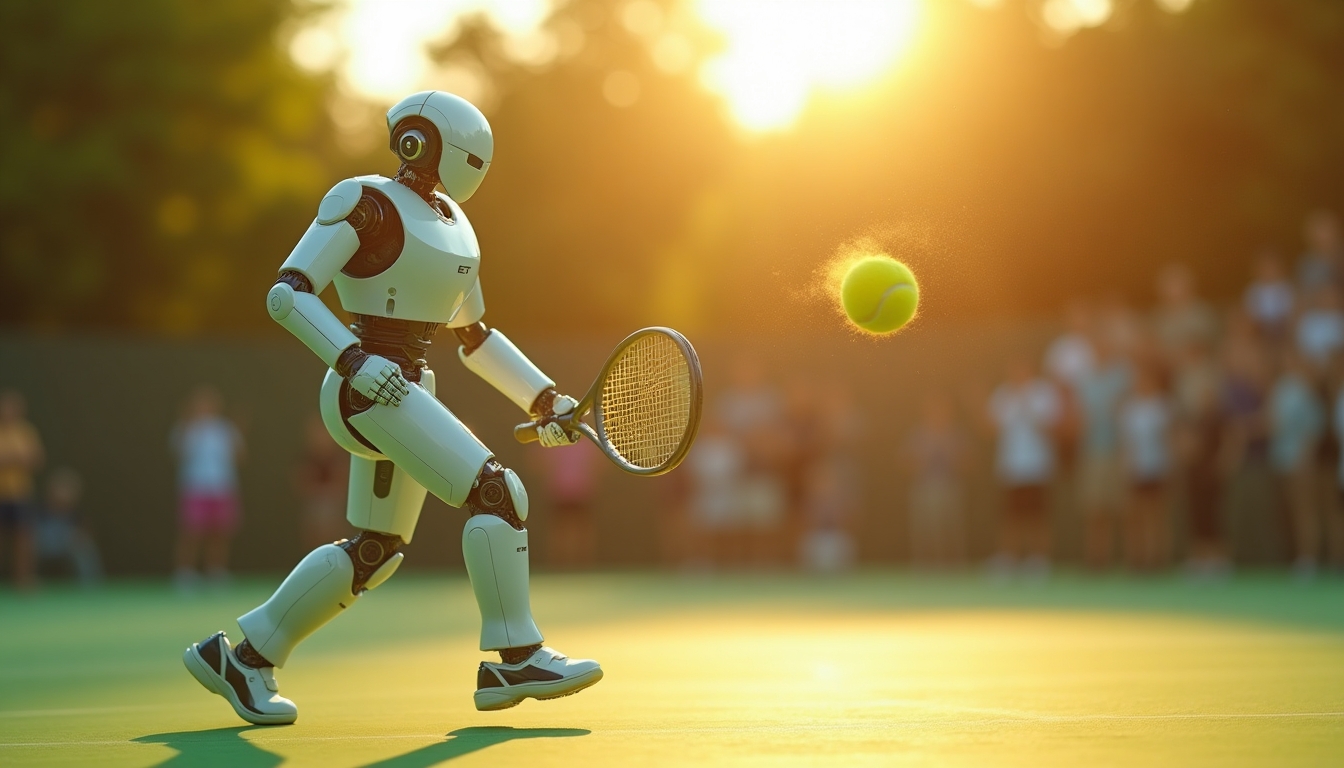
You might find it hard to believe, but in the world of robotics, an ambitious goal has just been struck: a
humanoid robot capable of playing tennis, a sport known for its demand on agility, precision, and intellect.
Let me explain how a group of dedicated researchers from China's leading institutions
such as Tsinghua University,
Peking University, and several others
have managed to achieve what was once only conceivable in science fiction scenes.
iN SUMMARY
- 🤖 A groundbreaking achievement in robotics sees a humanoid robot successfully learning to play tennis.
- 💡 Researchers utilized imperfect motion data from amateur players to train the robot.
- 🎾 The innovation solves the sim to real gap, aiding the robot in real-world applications.
- 🗝️ The architecture promises broader applications, from warehouse tasks to disaster recovery.
It all started with a challenge that many would consider close to impossible: teaching a two-legged robot
an athletic skill to connect real-time input with physical action. The choice of sport was tennis – an endeavor
that brings a unique set of challenges with its swift pace and precision demands. The ball speeds surpassing
60 mph (30 m/s) coupled with the need for instantaneous movement and coordination make tennis an exceptional
test for humanoid robotics.
The Robot Behind the Racket: Unitree G1
Meet the Unitree G1,
the robo-athlete that is rewriting the rules of capability in artificial intelligence-driven robotics. Though
modestly sized at 127 cm, about the height of a primary school child, the G1 doesn't just stand poised; it impresses.
With 29 degrees of freedom, it's equipped to emulate complex human movements, and it now wields a tennis racket
thanks to a specialized 3D-printed adapter. This robot was originally spotted gaining popularity in table tennis;
however, the real challenge awaited on the much larger and demanding terrain of the tennis court.
Ingenious Solutions for Real-World Challenges
Rather than starting with flawless data from professional players, researchers took a novel approach. They
constructed their program using the imperfect data of amateur tennis enthusiasts. From this small pool of five
amateur players, they gathered motion fragments in an area only 3x5 meters – significantly smaller than a full
tennis court. The insightful use of AI architecture allowed the motion data to morph into a comprehensive
framework capable of real-time athletic performance.

Breaking Through the Simulation Barrier
The key to the laboratory's success hinged upon eliminating the "sim to real gap" – the great disparity between
perfect simulation environments and untidy real-world conditions. To overcome this, the researchers added
unpredictable variables to their simulations such as noise, friction changes, and even slight alterations
in the robot’s mass distribution. The result is a robot so well-versed in chaotic conditions that real-world
play begins to look routine.
The Future of Robotics Beyond the Court
What’s the broader significance of a robot wielding a tennis racket? This technique of learning from incomplete,
messy data has potential far beyond the boundaries of tennis courts. It's a pioneering step forward in how robots
can be taught various physical tasks ordinarily reserved for humans. We've entered an era where athletic
robots may conduct tasks ranging from soccer and parkour to disaster recovery and warehouse operations.
Implications and Next Steps
The potential applications of this experiment are boundless. Companies such as
Figure
and Tesla,
known for their advancements in robotics, might soon revolutionize industrial tasks with humanoid robots that
learn through brief observation of human activities, negating the need for labor-intensive programming.
Further enhancement will see these robots utilizing on-board vision, heightening their adaptability in real
environments – truly a "game-changer" in every sense.
Dear reader, what do you think of the ongoing advancements in humanoid robotics? Are you ready to have robots as
your tennis partners, or perhaps envision these mechanical beings operating in diverse fields of labor?
Share your thoughts and join the spirited discussions within our growing community
at iNthacity.
Remember, every view and comment further enriches this conversation. Who knows – your next word could inspire the
next technological leap!
And, as we witness the dawn of this robotic revolution, let's find hope in knowing that no matter the strides
technology takes, laughter and a shared game of tennis, even with mechanical friends, will always be part
of our shared humanity. That's a future worth serving up!
Even robots know the importance of a good service game. Here’s hoping their sense of humor is just as impressive!
Wait! There's more...check out our gripping short story that continues the journey: The Echo of Dreams

Disclaimer: This article may contain affiliate links. If you click on these links and make a purchase, we may receive a commission at no additional cost to you. Our recommendations and reviews are always independent and objective, aiming to provide you with the best information and resources.
Get Exclusive Stories, Photos, Art & Offers - Subscribe Today!
Related posts:
 Mind-Blowing Humanoid Robot Walked Outside (The Internet Exploded)
 Major AI News: OpenAI Unveils GPT-4.5, Humanoid Robots Advance, AI Safety Concerns Rise, and More Updates!
 The Most Powerful AI Humanoid Robot Yet – Pudu D9 (Superior to Optimus)
 Meet Atlas: Boston Dynamics’ Humanoid Robot Takes on Warehouse Work with a Twist
 Major AI News Update: OpenAI Stunned, Meta’s Humanoid Robots Revealed, Breakthrough Quantum Chip, and More



Post Comment
You must be logged in to post a comment.