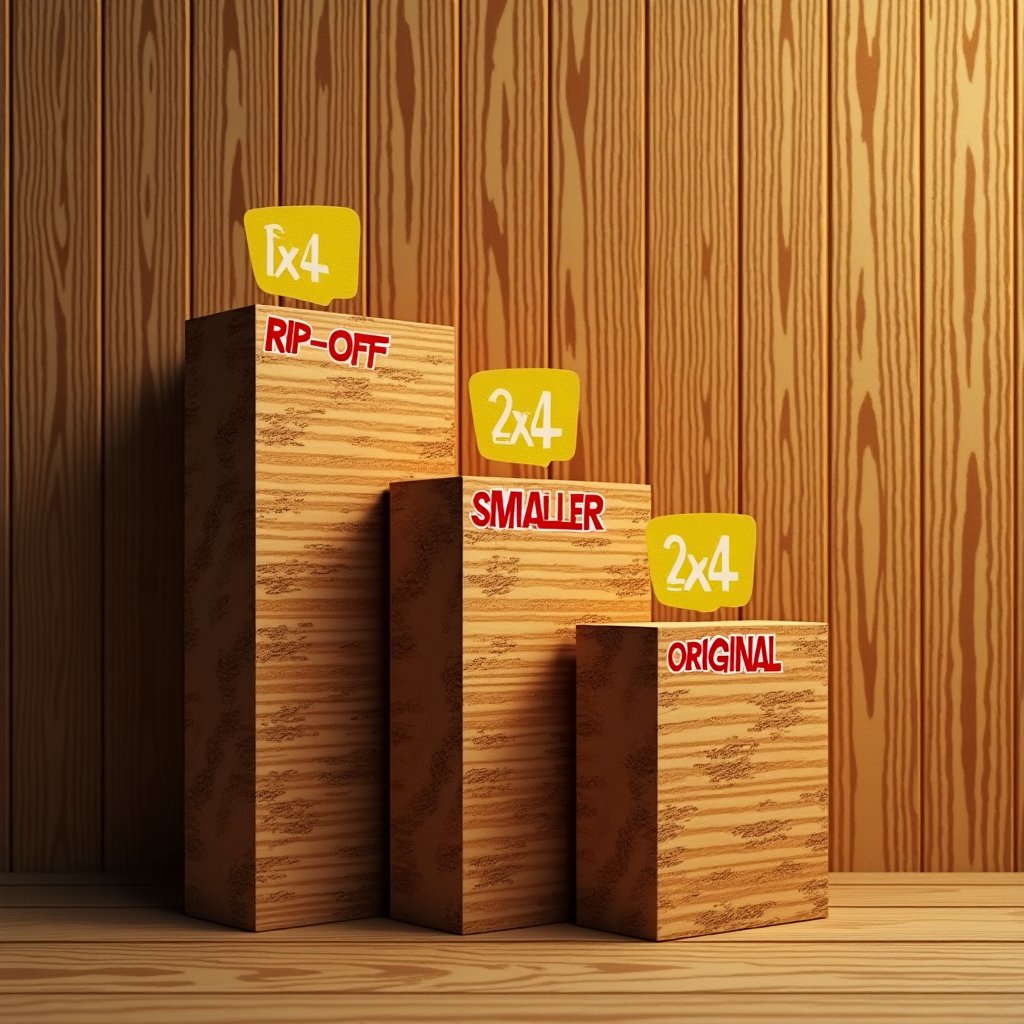
Have you ever wondered why your 2x4 lumber isn’t actually 2 inches by 4 inches? If you’ve ever picked up a piece of lumber from your local big-box store and thought, “This doesn’t look right,” you’re not alone. In fact, you’ve been lied to for decades. But don’t worry—Stumpy Nubs (James Hamilton), the woodworking guru behind the popular YouTube channel Stumpy Nubs, is here to spill the beans on the lumber industry’s dirty little secret. Buckle up, because this is a wild ride through the history of lumber, corporate greed, and how you can fight back.
The Good Old Days: When a 2x4 Was Actually a 2x4
Let’s take a trip down memory lane. Back in the day, a 2x4 was actually 2 inches thick and 4 inches wide. If you’ve ever worked on an old house, you’ve probably seen those robust studs that make today’s lumber look like toothpicks. But here’s the kicker: back then, there wasn’t much consistency. The thickness of the wood could vary depending on the mill, the operator, or even the day of the week. If Hank the mill operator had a few too many drinks on a Friday afternoon, you might end up with a 2x4 that was 2.25 inches thick. Crazy, right?
This inconsistency wasn’t a big deal when everyone was building their own homes. But as construction became more industrialized, the lack of standardization became a problem. Imagine trying to frame a wall with studs that weren’t all the same width or calculating the load on a floor with joists of varying thicknesses. It was a mess.
The Great Lumber Conspiracy: How Big Lumber Ripped You Off
Enter the powers that be. In the early 20th century, the lumber industry decided to standardize dimensions for construction lumber. Sounds reasonable, right? Wrong. What they came up with was one of the biggest scams ever pulled on the American public. They set the standard thickness for framing lumber at 2 inches and standard widths at 4, 6, 8, 10, and 12 inches. But here’s the twist: they didn’t actually give you those dimensions.
Why? Because money. West Coast mills had a surplus of trees, and shipping costs were based on volume, not quantity. So, the geniuses in the back rooms figured out that they could reduce the volume of lumber while increasing the salable quantity by making the wood thinner. And just like that, your 2x4 became 1.5 inches by 3.5 inches. But they still called it a 2x4. Why? Because calling it a 1.5x3.5 would have been too honest.
The Nominal Thickness Scam: How They Justified It
Now, you might be thinking, “Okay, wood shrinks when it dries, and they plane it smooth, so maybe it’s not that big of a deal.” But here’s the kicker: they could have cut the boards thicker and wider in the first place so that after drying and planing, you’d still end up with a full 2x4. So why didn’t they? According to the industry, the equipment back in 1964 couldn’t handle it. But that’s a load of baloney.
Anyone who’s ever bought rough-cut hardwood knows that it’s sold by the quarter-inch. A 1-inch board is called 4/4, a 2-inch board is called 8/4, and so on. The mills could have easily cut 10/4 lumber (which is 2.5 inches thick) and then dried and planed it down to a true 2x4. But they didn’t. Why? Because they wanted to waste your wood, not theirs. They wanted to charge you for the water and sawdust left behind at the mill.
The Reality of Modern Lumber: Twisted, Bowed, and Unreliable
Fast forward to today, and the situation hasn’t improved. If you’ve ever bought a 2x4 from a big-box store, you know that it’s rarely straight or dry. In fact, most of the lumber you buy today is green, meaning it’s still wet. And as it dries, it twists, bows, and warps like a bunch of arthritic bananas. So not only are you paying for less wood, but you’re also getting a product that’s harder to work with.
But don’t despair. There are ways to fight back. One option is to buy rough-cut lumber and mill it yourself. This way, you can ensure that you’re getting the dimensions you need and the quality you deserve. Another option is to invest in high-quality tools and materials that will last longer and perform better, like the Amana Tools spiral bits with Astra HP coating. These bits are coated with a microscopically thin, ultra-hard layer that reduces friction and heat buildup, leading to longer bit life and better performance.
What Can You Do About It?
So, what’s the takeaway from all this? First, don’t let the lumber industry pull the wool over your eyes. Know what you’re buying and why. Second, invest in quality tools and materials that will make your woodworking projects easier and more enjoyable. And finally, don’t be afraid to speak up. The next time you’re at the lumber yard and you see a 2x4 that’s clearly not 2x4, let out an audible sigh. Let them know you’re onto their game.
If you’re looking for more tips and tricks on woodworking, check out Ted’s Woodworking Plans. With over 16,000 plans, you’ll never run out of ideas for your next project.
Watch the Full Story from Stumpy Nubs
For a deeper dive into the history of lumber and the industry’s shady practices, check out the original video from Stumpy Nubs (James Hamilton). Trust me, it’s worth the watch.

Join the iNthacity Community
If you enjoyed this article and want to be part of a community that values quality, honesty, and craftsmanship, consider joining the iNthacity community. We’re a group of like-minded individuals who are passionate about woodworking, DIY projects, and making the world a better place, one board at a time. Sign up for our newsletter, participate in the debate, and become a permanent resident of the “Shining City on the Web.”
Final Thoughts
So, what do you think? Are you ready to take a stand against the lumber industry’s shenanigans? Will you invest in quality tools and materials to ensure your projects are the best they can be? Let us know in the comments below. And don’t forget to like, share, and subscribe to the iNthacity community for more tips, tricks, and insights into the world of woodworking.
Remember, the next time you pick up a 2x4, ask yourself: is this really a 2x4? Or is it just another piece of the lumber industry’s grand illusion? The choice is yours.
Wait! There's more...check out our gripping short story that continues the journey: The Emerald Codex

Disclaimer: This article may contain affiliate links. If you click on these links and make a purchase, we may receive a commission at no additional cost to you. Our recommendations and reviews are always independent and objective, aiming to provide you with the best information and resources.
Get Exclusive Stories, Photos, Art & Offers - Subscribe Today!
Related posts:
 Stop Using These Dangerous Table Saw Accessories Immediately – DeWalt, Bosch, and More Brands to Avoid
 The End of the Cordless Drill Era: Why Dewalt and Other Brands Are Revolutionizing Power Tools
 How Spax, GRK, and Modern Brands Have Revolutionized Simple Wood Screws for Better Performance
 The Hidden DANGER of DIY Wood Countertops: Why IKEA and Other Brands Recommend Professionals
 The Builders of Egrexia




Post Comment
You must be logged in to post a comment.