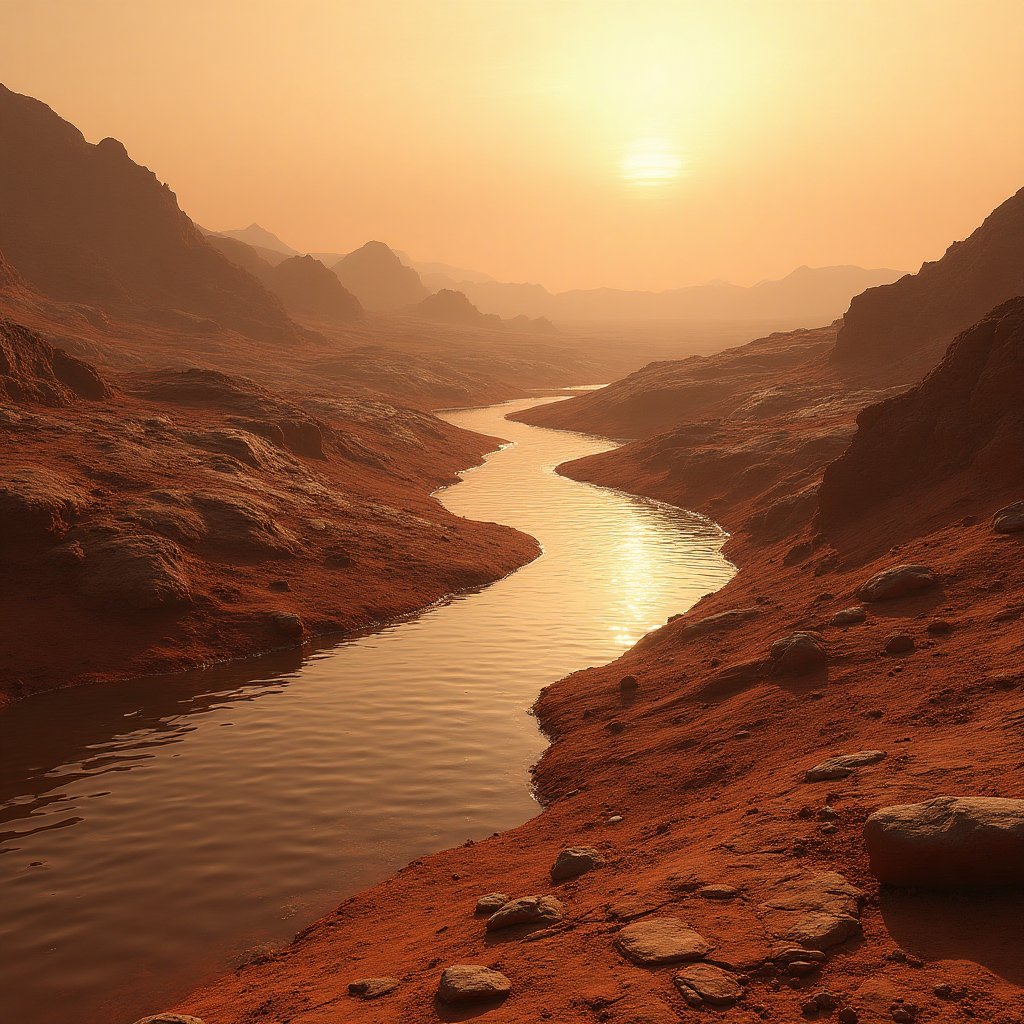
Mars, the Red Planet, has always fascinated scientists and dreamers alike. But new discoveries are revealing that Mars was once a place where rivers flowed freely, reshaping our understanding of its past. According to SciTechDaily, over 15,000 kilometers of ancient riverbeds have been identified on Mars. This discovery suggests that rainfall, not just glacial melt, once played a major role in shaping the Martian surface. Let’s explore what this means for our understanding of Mars and its potential for life.
Massive Network of Ancient Riverbeds
Scientists have uncovered over 15,000 kilometers of ancient riverbeds in Noachis Terra, a region in Mars’ southern highlands. These winding ridges, known as fluvial sinuous ridges (FSR), were likely formed when river-deposited sediments hardened and were later exposed as the surrounding landscape eroded. This extensive network of riverbeds suggests that flowing water was once common on Mars, pointing to a time when the planet may have been warm and wet.
The study, led by Adam Losekoot, a PhD candidate at the Open University, used high-resolution orbital data from instruments like the Context Camera (CTX), the Mars Orbiter Laser Altimeter (MOLA), and the High Resolution Imaging Science Experiment (HiRISE). These instruments allowed the team to map the locations, lengths, and morphologies of ridge systems across a wide area.
Geological Stability During a Climate Shift
The findings indicate that surface water may have been stable in Noachis Terra during the Noachian-Hesperian transition, a period of geologic and climatic change around 3.7 billion years ago. This suggests that Mars experienced warm and wet conditions for a geologically relevant period, challenging long-held views of the planet as cold and dry.
Noachis Terra has not been studied as extensively as other regions of Mars, in part because it contains few valley networks, which are branching erosional features that have traditionally been used to infer historical rainfall and runoff. The study instead focuses on fluvial sinuous ridges as an alternate form of evidence for ancient surface water.
Mars: A Martian Geological Time Capsule
“Studying Mars, particularly an underexplored region like Noachis Terra, is really exciting because it’s an environment that has been largely unchanged for billions of years. It’s a time capsule that records fundamental geological processes in a way that just isn’t possible here on Earth,” said Losekoot.
The team’s work provides new evidence suggesting that Mars was once a much more complex and active planet than it is now. This discovery not only reshapes our understanding of Mars’ past but also opens up new possibilities for finding signs of ancient life on the planet.
What Does This Mean for the Search for Life on Mars?
The presence of ancient rivers on Mars suggests that the planet may have once been habitable. Water is essential for life as we know it, and the discovery of extensive riverbeds indicates that Mars had the conditions necessary to support life in the past. This discovery adds to the growing body of evidence suggesting that Mars was once a water world, with a climate that could have supported microbial life.
As scientists continue to explore Mars, they are uncovering more clues about its past and its potential for life. The discovery of ancient riverbeds in Noachis Terra is just one piece of the puzzle, but it’s an important one that brings us closer to understanding the Red Planet’s history.
Warm and Wet Mars? Challenging Old Views
The fact that the ridges form extensive interconnected systems suggests that the watery conditions must have been relatively long-lived, meaning Noachis Terra experienced warm and wet conditions for a geologically relevant period. This challenges the old view of Mars as a cold and dry planet and points to a time when it may have been far more Earth-like than we imagined.
This discovery not only reshapes our understanding of Mars’ past but also opens up new possibilities for finding signs of ancient life on the planet. As scientists continue to explore Mars, they are uncovering more clues about its past and its potential for life. The discovery of ancient riverbeds in Noachis Terra is just one piece of the puzzle, but it’s an important one that brings us closer to understanding the Red Planet’s history.
Thought-Provoking Questions
What does the discovery of ancient rivers on Mars mean for our understanding of the planet’s history? Could Mars have once supported life? And what does this mean for the future of space exploration? Share your thoughts in the comments below.
Join the iNthacity community and become part of the "Shining City on the Web"! Apply to become a permanent resident and participate in the debate. Like, share, and comment to be part of the conversation!
Disclaimer: This article may contain affiliate links. If you click on these links and make a purchase, we may receive a commission at no additional cost to you. Our recommendations and reviews are always independent and objective, aiming to provide you with the best information and resources.
Get Exclusive Stories, Photos, Art & Offers - Subscribe Today!
Related posts:
 Unveiling the Matrix: Discover the Hidden Geometric Magic in AI Brains
 Archaeologist searching for Cleopatra’s long-lost tomb makes ‘significant’ new discovery
 Psychologist reveals the secret psychological details hidden in your iPhone app icons
 Ancient mysterious turtle sculpture is discovered in Holy Land cave after 35,000 years – and archaeologists believe people may have WORSHIPPED it
 Putin’s Mysterious Space Weapon: Kremlin’s Cosmos 2553 Satellite with ‘Dummy Warhead’ Could Devastate Rival Spacecraft and Earth





1 comment