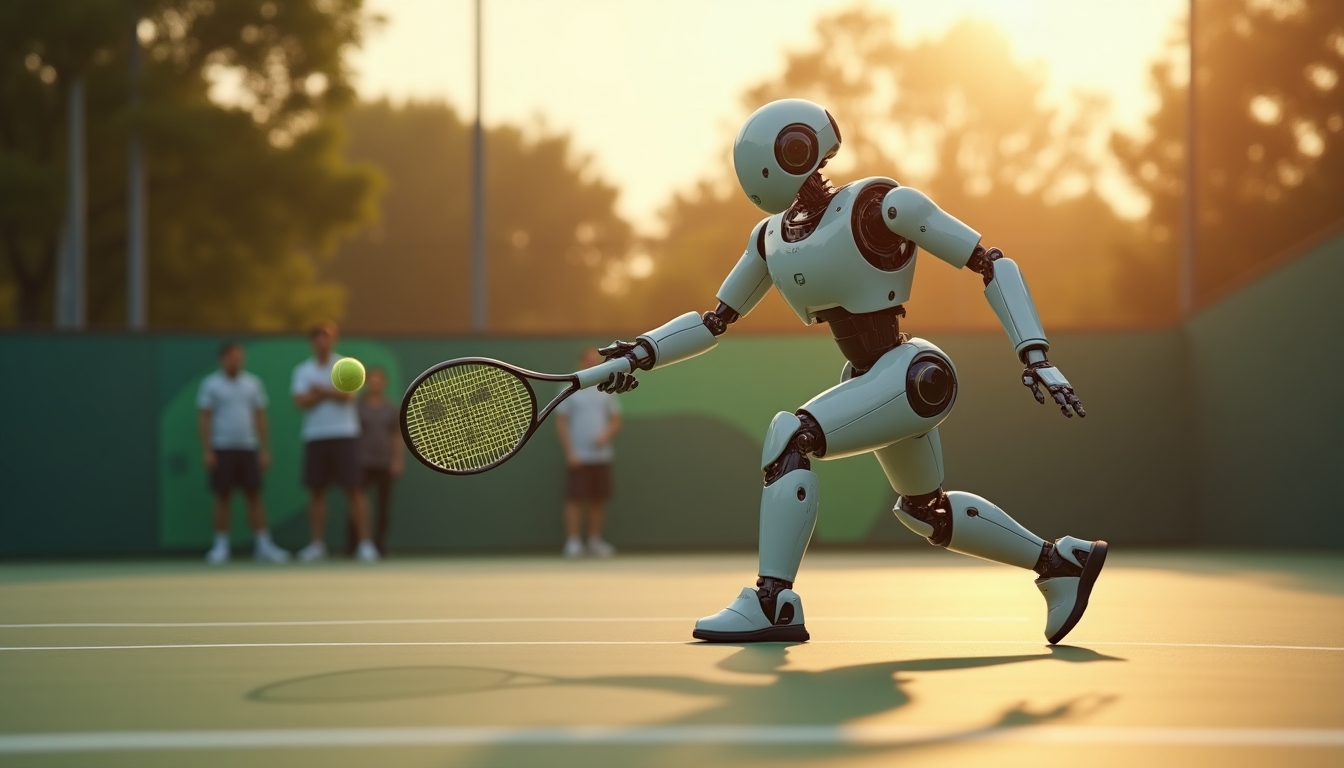
TheAIGRID has recently showcased a groundbreaking innovation that could potentially redefine our interactions with technology: a humanoid robot playing tennis. But it's not just about a robot swinging a racket; it's the culmination of a complex interplay of artificial intelligence, engineering, and human ambition. So, how did we reach this fascinating milestone?
iN SUMMARY
- 🎾 Innovative AI learning system, called Latent, turns imperfect human motion data into functional robot tennis skills.
- 🤖 A humanoid robot, like the Unitry G1, visually "learns" from amateur tennis players, despite size and joint limitations.
- 🌍 Success relies on a unique training method, adapting from virtual to real-world conditions with randomization techniques.
- 🚀 Potential applications extend far beyond tennis, potentially impacting fields such as warehouse logistics and disaster recovery.
The story begins with a select group of researchers hailing from China's prestigious institutions such as Tsinghua University and Peking University, collaborating with robotics company Unitree Robotics and the Shanghai AI Laboratory. Their task? Equip a humanoid robot with the athletic ability required to play tennis—a sport fraught with the challenges of speed, coordination, and real-time adaptability. No simple feat, given tennis balls can zoom across the court at velocities over 60 mph!
The Challenge of Teaching Tennis to Robotics
The team faced the Herculean task of instilling the ability to play tennis into a small humanoid robot called the Unitry G1. Imagine an anthropomorphic machine just over four feet tall, adorned with 29 joints that mimic human movement. The challenge was to equip this robot not only with the ability to swing a racket but to engage a human competitor, necessitating real-time tracking and full-body coordination. Essentially, the robot had to think on its "feet," which is a frontier seldom mastered by machines.

Latent: From Amateurs to Adaptability
The heart of the breakthrough lies in a system called Latent—short for “learning athletic humanoid tennis skills from imperfect human motion data.” It's an acronym clunky enough to make you chuckle, but its implications are exhilarating. Traditional methods might rely on capturing pristine data from world-class athletes. Instead, these researchers employed amateurs in a decidedly confined space, amounting to merely five hours of rudimentary tennis stance movements. Here lies a leap of faith: transforming imperfect and incomplete human motion data to create robot athletes.
Architecting the Virtual Athlete
Latent operates through a transformative three-layer architecture. Initially, human movements are converted into feasible robotic motions. Considering the inherent disparity between human and robot anatomies, this translation isn't about creating copies but functional equivalents—what can this robot’s arm achieve versus a human's swing?
The second layer, the "latent action space," abstracts movements into their essential forms. Rather than memorizing detailed muscle actions, it grasps the general motion's ethos, crafting new variations within its programmed domain. Finally, the "high-level policy" formulating the cohesive strategy—watching the ball, choosing shots, aligning the body—essentially gives life to this mechanically independent athlete.
From Simulation to Real-World Dynamics
Initially trained in a virtual environment, the jump to the tangible world introduces numerous unpredictabilities: minor imperfections, inconsistent surfaces, and limitless natural variables. Known in jargon as the "sim-to-real gap," it's an Achilles' heel of robotics. By simulating chaos—randomizing physics and environmental factors—the training adjusted for these discrepancies, forging a robot that thrives on chaos. In the real court, successes were laudable with forehands hitting the mark 91% of the time while the backhands presented a respectable 78% success rate.
A Proof of Concept with Limitless Potential
As researchers have elucidated, tennis serves as a mere “proof of concept.” This innovation harbors latent potential across numerous scenarios, whether they involve urgent response work, logistical warehouse dreams, or competitive sports. Think of humanoid robots adapting to tasks from scant human data, eliminating the necessity of extensive programming and costly data collection. This evolving methodology could redefine industries, one rally at a time.
The Path Forward
Next comes overcoming hardware limitations, seeking self-contained actors utilizing optical recognition rather than external sensors. Will multiple robots compete autonomously, perhaps bringing spectacle and strategic depth unseen by today’s metrics? Cross-applicability remains a riveting query. Can the foundational architecture modify for soccer, dance, or martial arts? Possibilities extend far into the horizon.
With advancements like the revolutionary Unitry G1, one cannot help but musing—could humanoid robotics fundamentally alter iNthacity's landscape of tomorrow? Share your thoughts in the comments. Let’s discuss how machines should redefine human activities or invite us to completely rethink our shared future. Invite others to become part of the iNthacity community, contributing to debate and innovation.
As transformations eagerly manifest, let us collectively wonder—will we all have humanoid tennis partners in the next decade, or will these technologic symphonies remain confined to academic lore? Only time will tell, and that’s the tantalizing part of it all.
Check out the latest international and national headlines for more innovations at iNthacity World News.
Stay curious, and remember: it only takes a gentle nudge to send a ball—and possibly an industry—soaring across the court.
Always remember, even robots need love, tennis and a good challenge. 😊
Wait! There's more...check out our gripping short story that continues the journey: Echoes of Argoth

Disclaimer: This article may contain affiliate links. If you click on these links and make a purchase, we may receive a commission at no additional cost to you. Our recommendations and reviews are always independent and objective, aiming to provide you with the best information and resources.
Get Exclusive Stories, Photos, Art & Offers - Subscribe Today!
Related posts:
 China’s Tennis Robot Unveils Shocking Breakthrough in Humanoid Innovation
 Mind-Blowing Humanoid Robot Walked Outside (The Internet Exploded)
 The Most Powerful AI Humanoid Robot Yet – Pudu D9 (Superior to Optimus)
 Elon Musk’s 20% Apocalypse: The Future of AI According to Tech’s Maverick
 Amazon’s Revolutionary New AI Models ‘NOVA’ Stun the Entire Tech Industry!




Post Comment
You must be logged in to post a comment.