

Editor’s note: This story first appeared in a Public Source neighborhood zine, a print project created to highlight the people, places and stories shaping Pittsburgh communities. Find a physical copy near you or view the digital version here.
Rich Trocchio is a Bloomfield old-timer who wants to see the neighborhood change.
“You could probably talk to 100 people and 90 would say the same answer: ‘We like it just the way it is,’” Trocchio said. “That doesn’t work anymore.”
On Liberty Avenue and its side streets, that tension is playing out in real time. Longtime residents and business owners say Bloomfield risks falling behind without new development, while others have resisted changes that could reshape the neighborhood’s character.
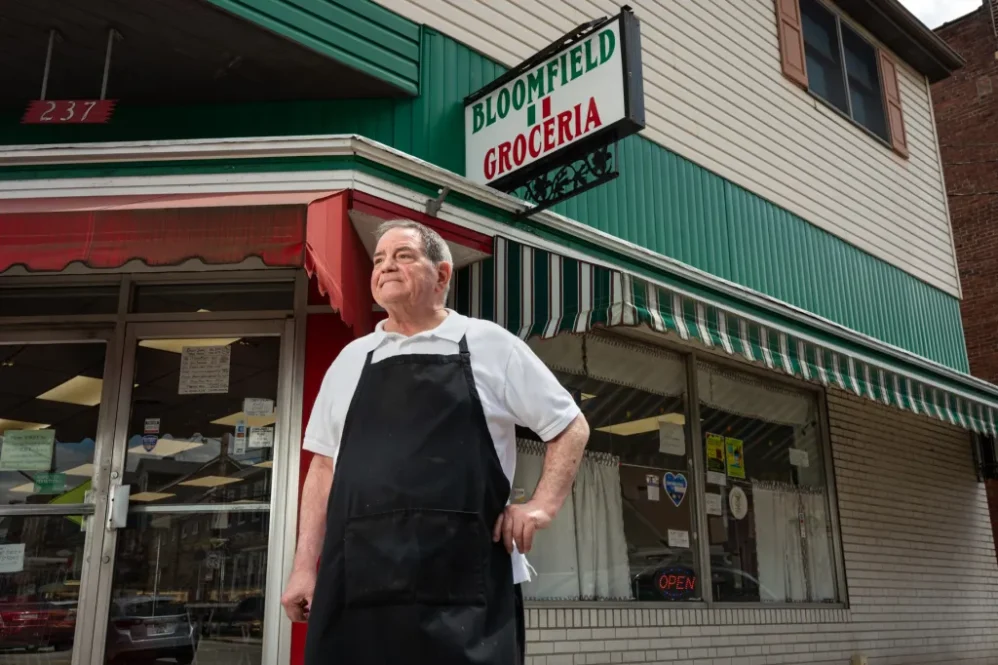
Trocchio is the owner (and sandwich maker) of Bloomfield Groceria, a corner store on Cedarville Street that is one of the few old Italian stores remaining in the neighborhood known as Pittsburgh’s Little Italy.

There’s a deli counter in the back, manned by Trocchio’s son, and neatly stocked shelves of pasta and other dry goods in the center of the store. Trocchio said a lack of growth in the neighborhood has cut down on the foot traffic needed to sustain stores like his.

“Bloomfield is so far down the shitter now,” he said. “What we need, we need right now, we need what’s happening in Lawrenceville.”
He was referring to the buildup of apartment buildings — and the new population and foot traffic that come with them — that has occurred on Butler Street over the past decade or so. One new development almost came to Bloomfield recently: A new grocery store and 248 apartments were planned for a plot near the Bloomfield Bridge, but the city’s zoning board rejected the plans after receiving some pushback from neighbors concerned about the size of the proposed building.
“I had a woman come in here and say, ‘We beat that thing,’” Trocchio said. “I said, ‘You blew it.’
“I can’t bring people in that don’t exist.”

Jamie Campau bought the Pleasure Bar in the late 2000s. Originally opened in 1941, it’s one of the oldest businesses still operating in the neighborhood.
He said business still hasn’t recovered from the impact of the COVID pandemic on the restaurant industry.
“I hate complaining — nobody had any idea what to do with the first pandemic in 100 years,” Campau said. “But they fucked COVID up. This place was shut down for three or four years. I still haven’t reopened the bar … with food costs increasing, it’s a completely new universe.”

He said the neighborhood’s texture is different from when he arrived in town about 20 years ago, but it remains an integral part of the city.
“It was a little more fourth-generation Italian” back then. “Rowhouses had grandmothers on the porch with grandsons patrolling the streets. All that’s gotten bought.”
A changing face
The neighborhood’s population has been relatively stable lately. Census estimates compiled by the University of Pittsburgh’s Center for Social and Urban Research show the neighborhood shrunk by 3% from the early 2010s to the early 2020s.
The neighborhood’s demographics changed more significantly: While still a predominantly white neighborhood, the area’s multiracial population more than quadrupled over the decade, according to the Census estimates, and the Hispanic population more than doubled. The foreign-born portion of the population rose from 9% to 13%.
Census measurements of self-reported ancestry show 35% of Bloomfielders in 1980 reported Italian ancestry. 22% did so in the most recent estimates.

Some neighborhood stalwarts like the Pleasure Bar and the Sacred Heart of Jesus are still around, and some new life has moved in. The Del’s building was taken over by Camino Cocteleria & Cocina, and Lombardozzi’s is now Fet Fisk, an award-winning, high-end Scandinavian restaurant. Other relatively new offerings include a taco spot (Baby Loves Tacos), a bagel shop (Phat Bagel) and a soup-centric cafe (Brothmonger).

New ambition, but no destination?
Two of the neighborhood’s newer entrepreneurs are Jay Imbrie and Jae Crone, who moved to the neighborhood together after opening the tabletop game shop Mimic’s Market. The pair does not see Bloomfield as a neighborhood in decline.
“Bloomfield was this hip place when we were growing up” in the South Hills, Imbrie said. When they were ready to start their business, “We knew Bloomfield was an up-and-coming queer neighborhood. We are a queer family, and it worked.

“I hope we’ve caught on to an early part of a wave here,” Imbrie said. “This is probably where we’re going to live for the rest of our lives.”
They said business is good, and they are beginning to look for more space to accommodate a growing range of game tournaments and events.
Produce shop owner Gina Merante has been in the neighborhood for more than a decade. She holds court at a table set up across the sidewalk from her shop, Linea Verde, telling regulars approaching the store to “go ahead in.”

“I don’t think there’s enough ambition,” in the neighborhood, she said. “We don’t have a destination. Donatelli’s was a destination.”
She said she wished that the building vacated by Del’s would have been turned into an outpost of the chain of mega-restaurants Eataly, “So you could go to Eataly at the entrance to Little Italy.”
Charlie Wolfson is a reporter for Pittsburgh’s Public Source. He can be reached at [email protected].
The post Liberty Avenue shows how Bloomfield changed — and where it could go next appeared first on Pittsburgh's Public Source. PublicSource is a nonprofit news organization serving the Pittsburgh region. Visit www.publicsource.org to read more.