
You probably think you are rational. Day to day, you try to “make the best possible use of the information available to you,” as MIT philosopher Brian Hedden PhD ’12 writes in his 2015 book, “Reasons without Persons.”
If you think you are rational because of how you plan for the future, and change your beliefs over time, however, Hedden will be skeptical. Circumstances change, and when using reason, he thinks, all that matters is the present. Thus, he also writes: “The requirements of rationality should be impersonal, avoiding reference to the relation of personal identity over time.”
This is what Hedden calls “time-slice rationality,” the idea that in applying reason, we exist in little slivers of time and knowledge. There are not permanently reasonable people, just reasonable decisions.
“We are temporally extended people with hopefully long lifespans, but we’re made up of lots of different time slices,” Hedden says. “So there’s me now, me yesterday, me next year. We should think of the locus of rationality as the time slice, not the temporally extended person.”
Those past versions of you, Hedden thinks, are like teammates in sports: You are connected to them, but not quite the same person. The payoff from viewing things this way, he contends, is a more streamlined and realistic picture of our thinking.
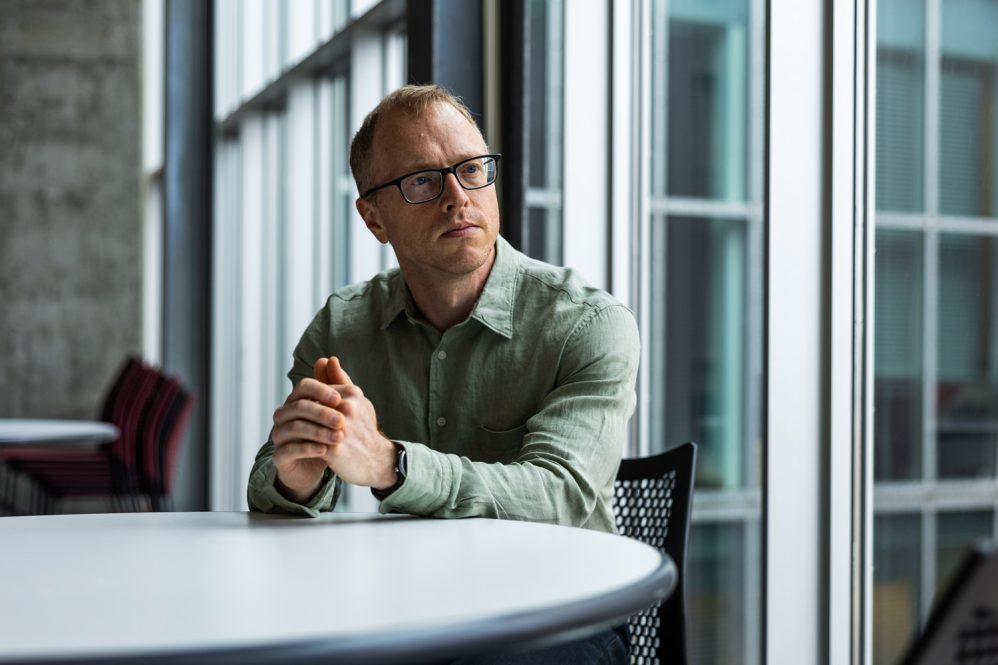
“Time-slice rationality” helped launch Hedden’s career. Today he is a professor in MIT’s Department of Linguistics and Philosophy and associate dean for MIT’s Social and Ethical Responsibilities of Computing (SERC) initiative. In a nod to his work, let’s examine some time slices from Hedden’s career.
Falling for philosophy
Hedden grew up in Virginia and attended Princeton University as an undergraduate, where he expected to study electrical engineering. But early on in college, he took some philosophy classes — an introductory course in logic, a history of early modern philosophy — and liked them. A lot.
“Engineering is still near and dear to my heart, but I really got into philosophy,” Hedden says.
Almost before he knew it, Hedden had found his primary intellectual interest. Upon graduating from Princeton, Hedden spent a year working for an education nonprofit in Nicaragua, but he had already decided on his next stop: graduate school in philosophy.
That led Hedden to MIT. He wanted to study the philosophy of language, and at MIT, the famous linguistics program is part of the same department as philosophy. Hedden applied to the Institute, was accepted, and arrived on campus eager to pursue his chosen field.
Lounge life
A funny thing happened to Hedden after he arrived at MIT, however: He stopped studying the philosophy of language. Blame Frank Gehry, the architect.
MIT’s Department of Linguistics and Philosophy is in the Stata Center, which opened in 2004 and was designed by Gehry to have all kinds of common spaces, including double-height lounges. After Hedden started graduate school at MIT, he got drawn into the philosophical discussions happening in these common areas. Before long, he had changed his intellectual focus.
“This was largely due to conversations that were happening in the lounge,” Hedden recalls. “The Stata Center has spaces that really encourage collaboration. A lot of people there were talking about puzzles involving probability, epistemology, and decision theory, and I found those things really stimulating, and wound up specializing in those areas. Things wouldn’t be the same if the building were differently arranged.”
Advised by MIT professors Caspar Hare, Robert Stalnaker, and Roger White, Hedden wound up writing his doctoral thesis — three papers — on rationality and decision-making. That formed the basis of “Reasons without Persons,” whose title alludes to a famous work by philosopher Derek Parfit.
While it might seem unusual to draw to draw a distinction between our past, present, and future selves, Hedden thinks we actually do that frequently, in everyday life and cultural work. In Greek mythology, Odysseus rationally chains himself to the mast of his ship, anticipating that his future self will be irrationally unable to resist the call of the sirens.
“That’s a dramatic example, but we do this all the time, like when we buy a gym membership and hope that our future selves will irrationally care about sunk costs and go to the gym to avoid having wasted the money,” Hedden says.
Heading down under
After earning his MIT PhD, Hedden spent two years as a junior research fellow at Oxford University, then landed his first faculty job in academia — at the University of Sydney, in Australia, in 2015. Five years later, he moved to Australian National University, in Canberra, leaving when he returned to MIT in 2025.
“I love Australia; I think the quality of life is amazing, the culture is great, the natural world is unbelievable,” Hedden says. The country also has, he observes, “a great philosophy scene,” fed in part by decades of interaction with American scholars.
Hedden’s work kept evolving during his decade in Australia. He started examining specific, applied topics more often, including many questions about legal processes and evidence. For instance: Should juries even deliberate? In one 2017 paper, Hedden suggested they should not, because, among other things, “deliberation destroys the independence of jurors’ judgments” in ways that can be counterproductive.
Or: Is there such a thing as “higher-order” evidence, which is evidence about what conclusions your evidence supports? In a 2021 paper, Hedden and now-MIT colleague Kevin Dorst concluded that virtually all evidence fits this billing.
Hindsight bias: Not bias
Or take another Hedden paper in this vein, from 2019, casting new light on the familiar topic of “hindsight bias.” We often alter our views about things after they happen, which can seem like gratuitous second-guessing.
Is it, though? Suppose you are investigating a railroad crash and find evidence that a crash was more likely than people imagined. That might simply be useful new knowledge. Suppose your favorite basketball team loses a game, and you reexamine why you thought they would win; perhaps a star player’s injury was more serious than you imagined. Are you changing your basic views, or just conducting a realistic reassessment?
“This is perfectly rational and what we should expect,” Hedden says. “Some people say, ‘Oh, that’s hindsight bias.’ I think it’s just a reasonable conclusion to draw.”
To be sure, in the paper itself, Hedden engages with theoretical philosophical work about evidence and view formation; much of his work bridges academic theory and practical everyday applications. Like many of his papers, this one also evinces the fun of reworking conventional wisdom.
“I do think that these contrarian views are right,” Hedden says. “But I also find a certain joy in going my own way, or having a skeptical take to get people to rethink views they’re falling into without fully realizing it.”
After an odyssey, back at MIT
After nearly a decade in Australia, Hedden received an offer to return to one of his intellectual homes: MIT offered him a place on the faculty. Arriving back at the Institute in 2025, Hedden found many things had changed — new buildings on campus, new programs — while some were recognizably the same.
“The philosophy department looks very similar in terms of the healthy culture,” Hedden says. “It’s always been known as a collaborative, high-energy place with a fantastic graduate program. And it’s really welcoming. That lounge discussion culture is still there. Sometimes cultures can be fragile. There could have been people who let it lapse. But it’s still there, and that’s great.”
Meanwhile, Hedden has added to his intellectual portfolio by becoming associate dean at SERC, a burgeoning initiative at MIT examining a wide range of civic issues around computing. SERC has supported 40 postdocs around MIT since 2022, in all five MIT schools plus the MIT Schwarzman College of Computing. It has also awarded 30 seed grants for faculty research in the last three years.
“There’s been really broad interest from faculty and students,” Hedden says. “I’m interacting a lot with computer scientists especially, but people across the Institute everywhere. The College of Computing is a unifying force.”
For that matter, the SERC Scholars program had 75 students accepted last fall, from first-year undergraduates to doctoral candidates, working on projects including surveillance, artificial intelligence, the energy impact of the sector, and more. Hedden is also making a point to develop more courses across SERC topics.
“It’s often the younger people, undergraduates and graduate students, the postdocs, the junior faculty, that gives us a constant infusion of new ideas and energy,” Hedden says. “We’re hoping to keep the momentum going.”
In this slice of time, that sounds pretty reasonable.
Source: News Boston – MIT