
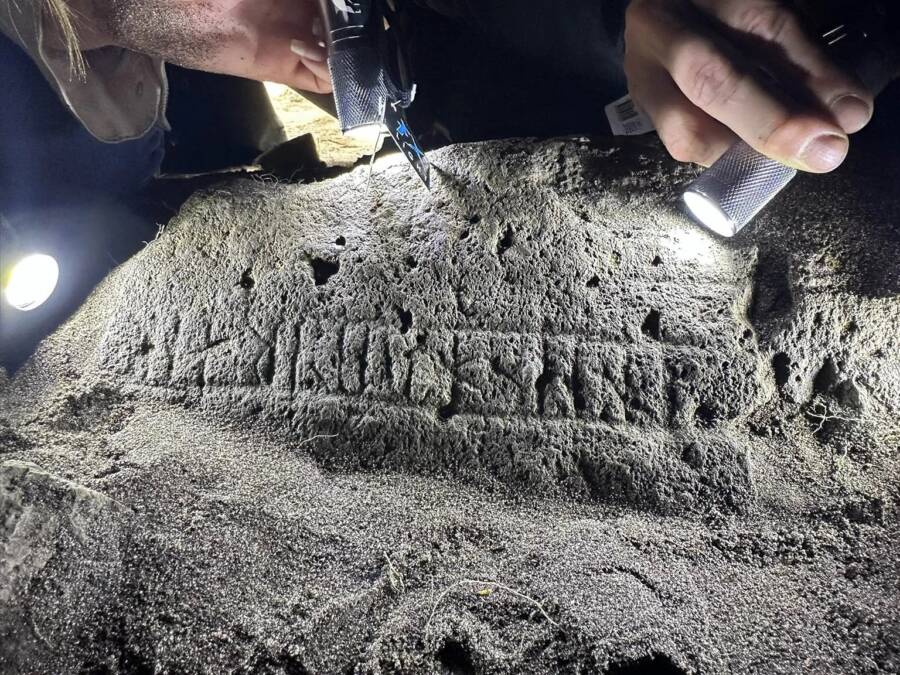
Helgi Michelsen/National MuseumAfter initial examination, archaeologists believe the runestone’s opening words read “Here lies…”
Archaeologists in the Faroe Islands recently made a rare discovery: a mysterious runestone embedded into the floor of what they believe was once a medieval chapel.
The Faroe Islands, a self-governing archipelago within the Kingdom of Denmark, sit in the North Atlantic Ocean roughly halfway between Iceland and Scotland. These remote islands, though small and relatively sparsely populated, possess a rich medieval history — and this discovery only adds to it.
The Mysterious Runestone Found Embedded In The Floor Of A Medieval Chapel
The find was made at the archaeological site Á Sondum on the island of Sandoy, during an excavation run by the Faroe Islands National Museum in partnership with Aarhus University and the Moesgaard Museum in Denmark.
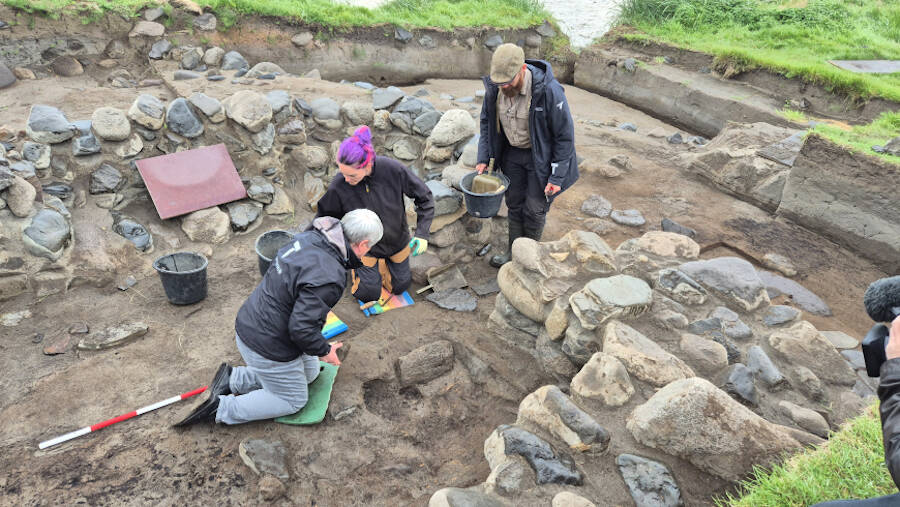
Helgi Michelsen/KVFArchaeologists on the island of Sandoy found the runestone embedded in the floor of a medieval chapel.
Á Sondum has long been a crucial site for archaeological discoveries that have helped researchers understand the archipelago’s history of human settlement, which stretches back before the dawn of the Viking Age.
Despite the region’s wealth of archaeological treasures, the National Museum said that it’s rare for a runestone to be found on these islands, and that this discovery will prove significant in understanding the archipelago’s medieval history.
Archaeologists found the stone embedded into the floor of a medieval building that was uncovered in July. Parts of the stone are broken and some of the runes are missing or difficult to read, due to damage and natural weathering over the centuries.
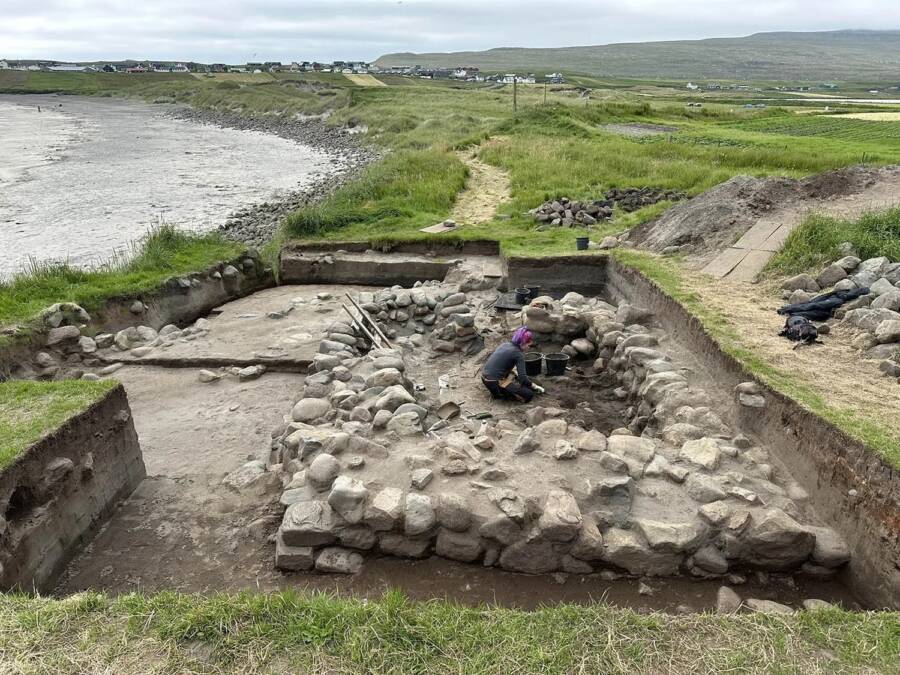
Helgi Michelsen/National MuseumThe runestone was transported to the Faroe Islands National Museum to protect it from the elements.
Still, National Museum archaeologists offered a preliminary translation of the opening piece of the runestone’s inscription: “Her hvílur…,” which is Old Norse for “Here lies…” or “Here rests…”
Because the runestone is not well-preserved and thus difficult to decipher, the museum sent for a specialist rune scholar, who is expected to join the research team in the Faroe Islands in late August in order to examine the stone.
If the opening phrase’s translation is confirmed by experts, this would suggest that the stone was possibly used for a memorial or burial marker.
The Faroe Islands broadcaster KVF also reported that the newly-discovered stone will undergo 3D scanning, the goal of which is to create an intricate digital model of the stone before any further deterioration of its surface occurs.
In the meantime, archaeologists moved the stone from Á Sondum to the National Museum for study and protection from the elements.
What This Rare Discovery Reveals About Early Christian Practices In The Faroe Islands
Because the Faroe Islands have a relatively short archaeological history of runic inscriptions, this find provides a rare window into the people who lived and worshipped in Sandoy during medieval times.
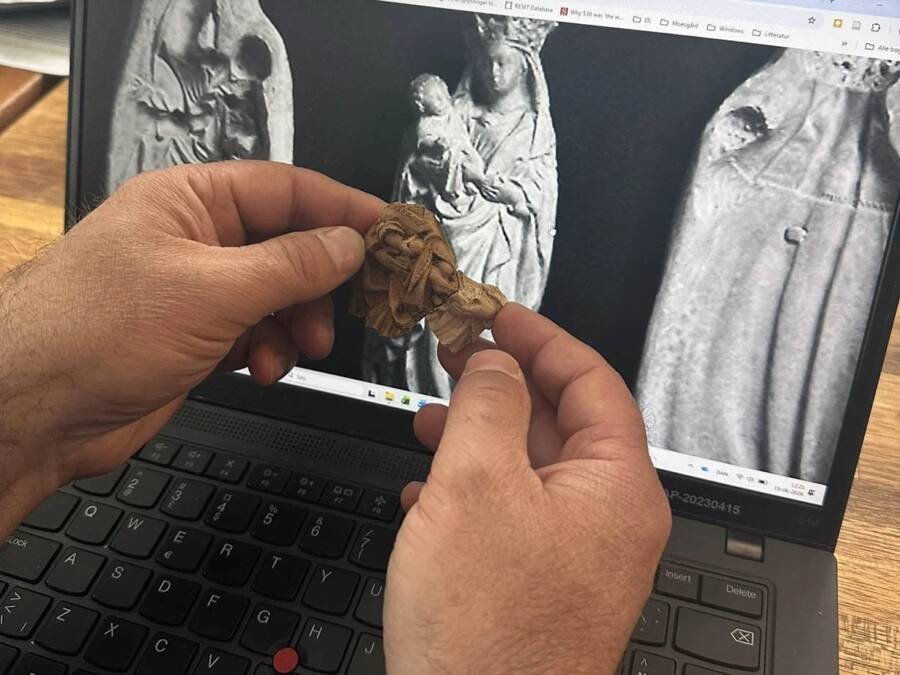
Helgi Michelsen/National MuseumThe team also found fragments of a small statue of the Virgin Mary holding the baby Jesus at the ruins of this same medieval structure.
In the building where the runestone was found, archaeologists also discovered pieces of a small sculpture depicting the Virgin Mary holding the baby Jesus, as well as a kola, a type of small oil lamp.
These objects, alongside the runestone, suggest that the building served as a place of early Christian worship. Its architecture also aligns with that hypothesis, as the building runs east to west with its entrance on the western side, a common layout among medieval chapels in the region.
In particular, archaeologists believe that the building was a medieval oratory, or small prayer house. Similar buildings have been uncovered in other locations in the Faroe Islands, including the oratory at Bønhúsberg on Mykines, Bønhústoft in Leirvík on Eysturoy, and a site with ruins at Bakki in Velbastaður on Streymoy.
While these other sites provide archaeologists with useful context for interpreting this recent discovery, the true purpose of the newly-unearthed runestone — whether it marked a grave or served a different religious function altogether — is still unclear for now.
After reading about the rare medieval runestone discovered in the Faroe Islands, learn about the Faroe Islands’ regional custom of slaughtering more than 1,000 dolphins. Then, discover the story of the world’s oldest runestone, found in Norway.
The post A Medieval Runestone With A Mysterious Inscription Was Just Found At The Ruins Of A Chapel On The Faroe Islands appeared first on All That's Interesting.
Source: Learn – allthatsinteresting