
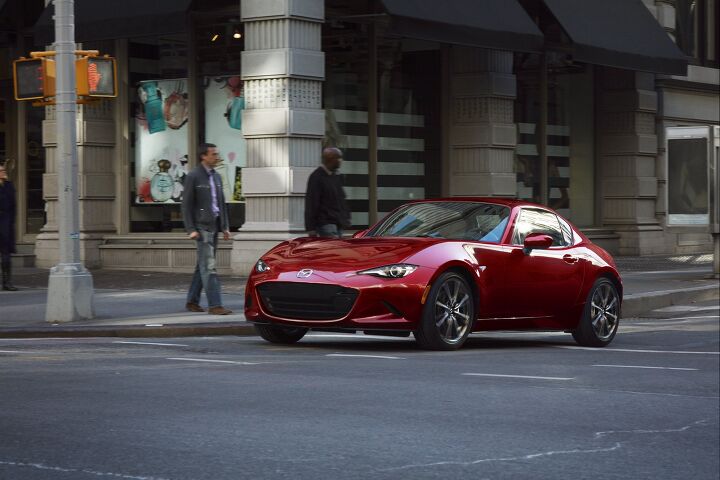
Mazda’s top dog, Masahiro Moro, has reportedly stated the company is seriously considering offering an electrified version of the next MX-5 Miata.
Since the current generation of the MX-5 has been in production since 2015, it seems likely that Mazda would have already started development on such a vehicle. CEO Moro even told Auto Motor und Sport that the car needs to be ready for a possible future where it’s sold exclusively as an EV.
“The [MX-5] successor must also be ready for a scenario without an internal combustion engine. The challenge for us is to make the basic construction easier without using exotic materials such as [Carbon Fiber Reinforced Polymer],” he told the German outlet.
Considering that the whole point of the Miata was to exist as a lightweight and affordable roadster, the above is somewhat concerning. Pivoting to battery power is presumably going to add a lot of weight to the vehicle and we know that automakers have failed to sell EVs at competitive prices. Mazda could very easily change the fundamental characteristics of the MX-5 and where it resides on the market.
But Moro said that the company would be targeting a curb weight that’s not much different than today. “The target for the developers is between just under 1,000 and 1,200 kilograms. And I think we can do it,” he explained.
While the Miata has gotten increasingly heavy since it launched in 1989, it always tends to be a featherweight relative to most other sports cars. Still, even a small battery pack can add several hundred pounds.
However, we’ve also seen fairly recent interviews where Mazda engineers stated that an all-electric MX-5 would be out of the question. Perhaps most recent was a chat between Christian Schultze, Director Research and Operations of Mazda Motor Europe, and Dutch outlet AutoRAI — which suggested that the car could instead become a hybrid to satisfy emissions.
Going back to 2025, we have examples of Mazda leadership stressing how best to keep the next-gen Miata lightweight while also satisfying increasingly aggressive emission rules. Chief Technical Officer Ryuichi Umeshita told Road & Track that the car absolutely had to be as lightweight as possible.
“I would say the most important thing is that it is lightweight,” said Umeshita, “and that the second most important thing is that it is lightweight.”
That sentiment was also echoed by Design Boss Masashi Nakayama.
“When I started designing this fourth generation, there was a request from the United States to make the car bigger, and to increase the power of the vehicle,” he explained via a translator. “I said, ‘Do you really want a Harley-Davidson?’”
“When we have to select an alternative out of two, there is a simple principle to make the selection,” Nakayama continued. “We tend to select the ones whose parts are less expensive, lighter and smaller. By doing so, we can prevent a car from being too big. When we consider the next-generation MX-5, we are considering making it less than one tonne in weight, and less than four meters in length.”
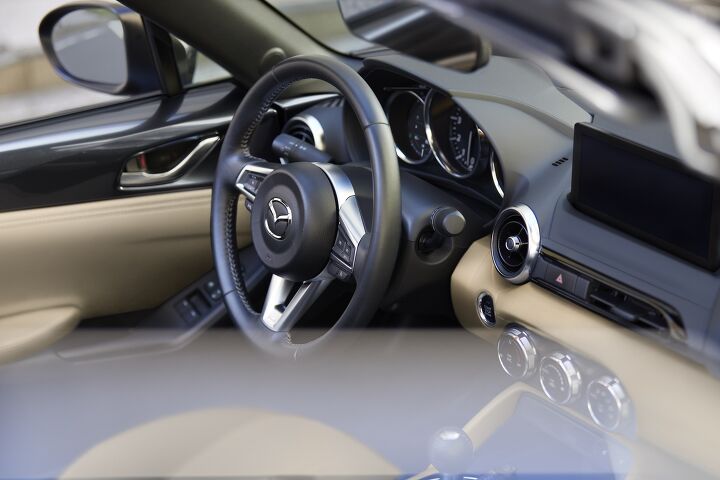
At the time, there was a lot of talk about using the latest version of the brand’s Skyactiv engines. While other brands were heavily focused on developing EVs, Mazda had continued trying to make internal combustion engines more efficient by running at higher compression ratios. The most advanced of these can run extremely lean and use extremely high pressures to help ignite the fuel similar to diesel engines.
The theory was that Mazda could simply install a smaller motor into the next MX-5 that leveraged the latest Skyactiv technology. Power presumably wouldn’t be staggering but it would satisfy stringent European emission requirements while being more than sufficient on an extremely lightweight vehicle. The formula would remain largely unchanged from previous generations.
Electrification, even if we’re discussing hybridization, risks undermining the core principles of the Miata. Balance could be retained thanks to EVs typically having a very low center of gravity and we know electric models can deliver blistering low-end acceleration. But there are other factors to consider.
For starters, the MX-5 has historically been one of the most-reliable sporting cars a person can buy. Pivoting to an entirely new powertrain (hybrid to pure EV) could result in some hiccups, especially since Mazda is kind of new to electrification. However, the assumption is that it’d be getting some help from Toyota — which has more experience with both.
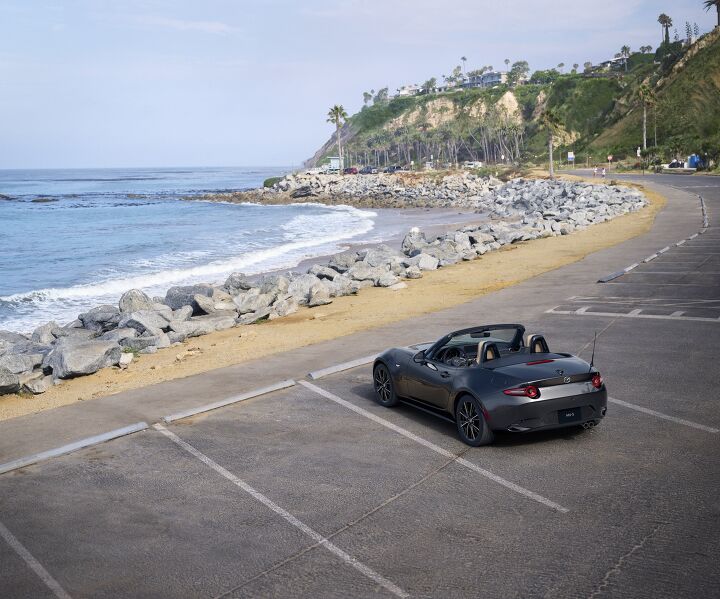
While the MX-5 boasts a relatively small fuel tank and minimal storage, it’s also something a person could take on a long drive without many concerns. Fuel economy tends to be excellent and the cabin is comfortable enough to spend a lot of time in unless you’re exceptionally tall or particularly sensitive to road noise.
Hybridization wouldn’t impact much of the above. But full electrification certainly would, especially if Mazda strives to keep the vehicle as light as possible by making the battery pack small. Even though recharging has gotten significantly faster in recent years, pouring in a few gallons of gasoline is still the quickest and most convenient way to make a pitstop.
The more one looks into the situation, the more it seems like Mazda might need to tailor the car to appease various markets. Interviews taking place in the United States frequently have the automaker discussing how combustion engines are the best way to ensure the MX-5 will remain lightweight. These are often accompanied by claims that the car will receive a 2.5-liter Skyactiv-Z. European interviews are significantly more likely to discuss electrification and running with smaller displacement engines — the latter of which is something Mazda already does.
The current MX-5 is sold exclusively with a 2.0-liter motor in the United States, whereas Europe also receives the smaller 1.5-liter SkyActiv-G. There are also some minor differences in the hardware and software used on the 2.0-liter model, with the brunt having everything to do with satisfying emissions.
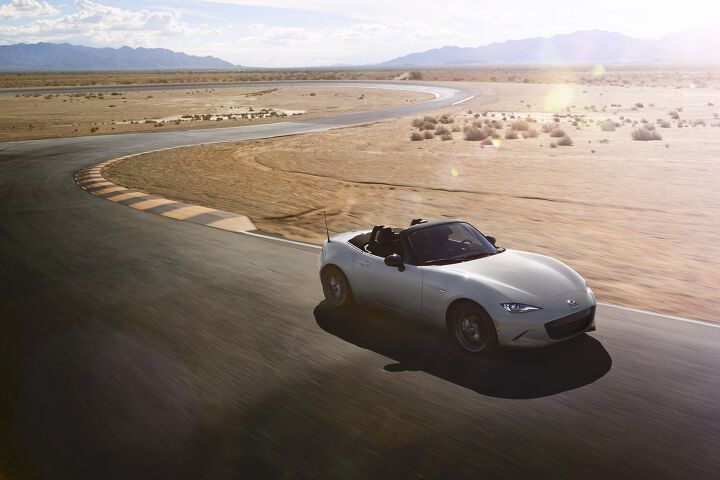
This is hardly unusual for global models, with the Miata historically following suit in order to cater to the rules of individual countries. Our guess is that the same will be true for any prospective electrification.
We doubt that an all-electric MX-5 would be a big hit in North America. But we may still see it as an option in the coming years. It just seems more plausible that an electrified Miata, which Moro seems to be confirming, would primarily exist to satisfy regional emissions. Europe would presumably continue seeing smaller engines and more electrification, while American customers should be able to nab something with more displacement.
The big concern is how taking a mixed approach will play out for the next-generation of the MX-5. Plenty of automakers are now manufacturing vehicles that can accommodate combustion engines and all-electric powertrains. But this has yielded mixed results, as developing a vehicle that can do both often means making sacrifices.
Automakers like the concept because it means they can more easily accommodate government emissions while limiting production costs. But drivers are occasionally saddled with vehicles that probably would have been a better EV or ICE model if the manufacturer had initially developed them as separate models.
We’ll see how the strategy plays out for Mazda in the coming years. Nobody expects to see the next-generation MX-5 until at least 2028, with some claims suggesting it might not arrive until 2030. While there’s a lot of lingering talk about how this will also be the final run of combustion models in Europe, which is plotting emissions restrictions that would practically ban combustion engines by 2035, the continent has repeatedly been forced to push back its previous targets. Meanwhile, the United States has aggressively walked back its own emissions targets to better suit consumer tastes.
[Images: Mazda]
Become a TTAC insider. Get the latest news, features, TTAC takes, and everything else that gets to the truth about cars first by subscribing to our newsletter.
Source: Autos – The Truth About Cars