
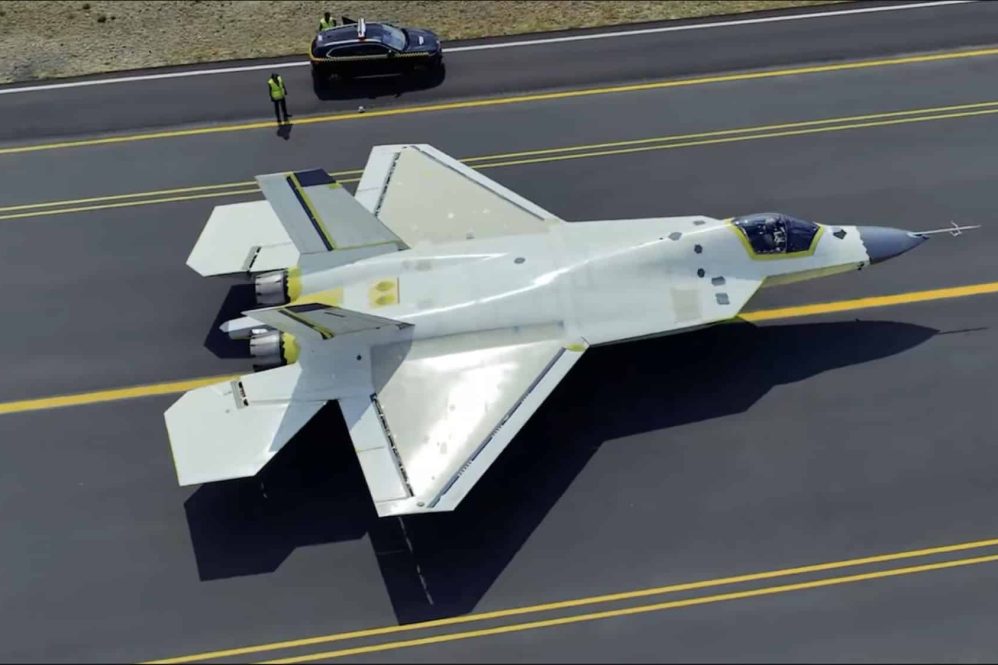
The Kaan’s second prototype is undergoing taxi testing, with Turkish officials indicating that the aircraft may begin flight testing before the end of 2026.
One of the two new prototypes of Turkey’s Kaan fifth generation fighter, P1, finally began taxi trials on Jul. 31, 2026. The aircraft was first revealed at the facility of its manufacturer Turkish Aerospace Industries (TAI/TUSAŞ) in February 2026 along with P2.
TAI released a video showing the aircraft already parked outside the hangar on the apron, before it began rolling down the taxiway on its own power. This test represents the first step in the run up to the first flight, checking the aircraft’s systems and ground handlings at various speeds.
P1 and P2 are supposed to be production representative airframes, learning from the experience and lessons learnt from prototype P0. For P1, TAI officials and Turkish defense commentators have indicated that the flight testing will begin before the end of this year.
The KAAN P1 design lines is now fully revealed from many different angles. Compared to the P0, the fuselage has taken on a much more aerodynamic and aesthetically pleasing form. The KAAN will be a true masterpiece. Congratulations to our TUSAŞ engineers https://t.co/sR5BAlFRXM pic.twitter.com/bUqGHXnQ5Z
— TR_tech (@T_Nblty) July 31, 2026
We had reported about a second prototype in September 2025, when it was spotted behind P0 in official footage of a Turkish military veterans organization. The fact that Turkish defense media’s earlier claims that a third prototype (P2) was under construction were confirmed in February 2026 underscores Ankara’s determined effort to field an indigenous fifth-generation fighter capability.
#KAAN pic.twitter.com/wWXXweP4af
— Türk Havacılık Uzay Sanayii (@TUSAS_TR) July 31, 2026
Kaan P1 prototype
This is what we had written in our previous report comparing the design of prototypes P1, P2 and P0:
“[…] the P1’s nose section appears to be wider, while the engine intake also appears to be taller, overshooting the chine line on the fuselage, and a little closer to the canopy. A major spot is the Tulgar Helmet-Mounted Display (HMD) fifth generation headgear […] seen through the cockpit canopy on the seat [of the P1].”
Ankara | TUSAŞ Tesisleri
Millî Muharip Uçak KAAN Projemiz kapsamında, KAAN hangarımızı ziyaret ederek tam boy statik test uçağımızda gelinen son aşamaya ilişkin kapsamlı bilgi aldık ve sahadaki çalışmaları yerinde inceledik.
2024 yılında ilk uçuşunu icra eden ve ilk… pic.twitter.com/mipIGkTtSs
— Prof. Dr. Haluk Görgün (@halukgorgun) February 13, 2026

“One difference in the design between the P0 and P1 is that the engine intake has been moved much behind in the fuselage, and is exactly under the boundary line of the cockpit hinges. This creates more space for self-defensive sensors like missile proximity, radar warning, directional infrared countermeasures or other arrays concerned with giving all-round 360 degree visibility, like the F-35’s Distributed Aperture System (DAS). The main landing gears are also moved a little further to the side, now emerging only partly from the underbelly. This also provides some space for both external and internal ventral weapons stores. Most importantly, a top view shows that the distance between the both engines in the P1 has also increased.”
Comparison of the KAAN P1 prototype with the P0
There has been some change in the fuselage back geometry. You can see the changes in the slope lines. (Image-1)
— TR_tech (@T_Nblty) February 14, 2026
Most importantly, the P1 has a prominent forward-looking sensor outside the canopy above the nose – a positioning suited for a multipurpose Forward-Looking Infrared (FLIR) and an Infrared Search and Track (IRST). These are used for passive target tracking and discrimination.

Another faceted sensor on the chin is in a position consistent with an air-to-ground tracking role. The shape of these optical systems are nearly identical to the Karat IRST and the Toygun Electro-Optical Tracking System (EOTS) tested on a new Kizilelma prototype. It is possible the one on Kaan P1 could be their derivatives.
Kaan, F-35, S-400 and geopolitics
The country is also hedging against a future disruption in the supply of the U.S.-origin General Electric F110-GE-129 by accelerating the development of the indigenous Tusaş Engine Industries (TEI) TF35000 engine, which is hoped to come online and be certified for future production batches. This reflects the premium placed on reducing Western leverage on strategic defense technology.

The F110s are assembled under license in Turkey but are still subject to U.S. export control restrictions. Even with the ongoing development of a new engine, Turkey will still need the F110 for the initial prototype fleet and the early low-rate initial production airframes.
Reporter: Türkiye wants the F-110 jet engines, and they want their F-35 fighter jets. Are you going to Türkiye with a big gift bag?
Trump: I think so. He’s a member of NATO. Some people don’t consider himself, but he really is.
He is a strong member of NATO. Yeah, I’m going to… pic.twitter.com/O2Yda1Vs3n
— Clash Report (@clashreport) June 24, 2026
Reuters reported in June 2025 that President Donald Trump has decided to green light a $700 million sale of F110s to Turkey. Turkey has also been lobbying to be admitted back into the F-35 program after being booted out in 2019 over its acquisition of the Russian S-400 system.
There are periodic reports about Turkey reaching an understanding with the U.S. over mothballing the S-400 and sending it to Ukraine, with the latest being agreeing to send it to an unidentified Gulf monarchy. Some reports claim it is the UAE.
Le turc #TUSAŞ
annonce que le chasseur #KAAN recevra le moteur national TF35000 dès 2033.https://t.co/s1z6VPAPjO pic.twitter.com/iiF9tcfVTu
— Juan Agullo
(@JuanAgulloNews) July 27, 2026
Kaan’s development is partly motivated by wielding a domestic option before the Americans and threatening its leverage over a major NATO ally that has long been a vital tool against Russian interests in West Asia. Likewise, Turkey’s SİPER surface-to-air missile (SAM) system is also being touted as an alternative to the S-400 itself.
This is beside an impressive array of other homegrown aircraft, armed drones and advanced munitions programs driving Turkey’s strategic rejuvenation in West and Central Asia.
Source: Travel – theaviationist