
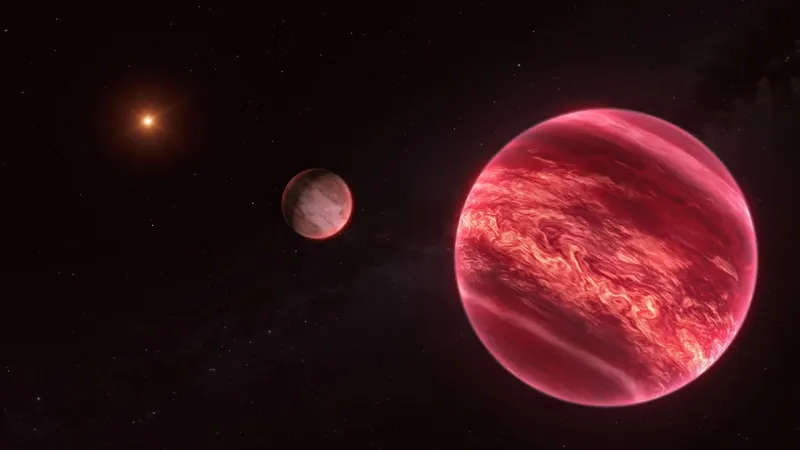
A newly discovered cosmic object is unlike any seen before. It’s not a planet. It’s not a moon, either. It’s a third thing we don’t have a name for yet.
The newfound object is about as massive as Jupiter and orbits a brown dwarf. That’s an object much bigger than a planet, but too small to burn hydrogen and shine as a true star. The brown dwarf, in turn, loops around a star called CD-35 2722.
This star system is the first known to host an “exosatellite,” researchers say. They shared the discovery July 22 in Nature.
The team coined the term “exosatellite” for the new object because no existing word is quite right. It’s not exactly an “exoplanet,” a planet around another star. Nor is it an “exomoon,” a moon around an exoplanet.
An object orbiting a brown dwarf orbiting a star “is so different from the structure of the solar system that all the words we invented to describe the solar system just aren’t really working,” says Kevin Hoy. He’s an astronomer at the University Diego Portales in Santiago, Chile.
He and others used the Very Large Telescope in Chile to observe the brown dwarf between 2023 and 2026. They saw periodic shifts in wavelengths of light emitted by the brown dwarf. This revealed that the gravity of a massive object must be tugging it to and fro.
Astronomers have used the same technique to find planets around other stars. But this is the first time the method has turned up what Hoy calls a “moonish thingy.” That is, something orbiting a bigger something that’s orbiting a still bigger something.
Does that nested setup make the new object a moon? Hoy doubts it. “It feels so off,” he says. “We’re probably not going to get away with calling it an exomoon.”
Technically a planet?
The new finding restarts an old debate about what counts as a planet.
Scientists came up with the current definition of an exoplanet in 2018. The International Astronomical Union, or IAU, devised it. (The same group decided that Pluto is not a planet, but rather a dwarf planet, in 2006.)
That definition lists a couple criteria for an exoplanet. It must be at most 13 times the mass of Jupiter. And it must orbit a star, a brown dwarf or the dense orb left behind after a massive star explodes.
Under those terms, a Jupiter-sized object orbiting a brown dwarf is a planet. It doesn’t matter that the brown dwarf then orbits a star.
“That kind of forces the companion to be a planet,” says David Kipping. This astronomer at Columbia University in New York City did not take part in the study. But he’s been searching for exomoons for more than a decade.
“We can argue about if the IAU definition is wrong or right,” Kipping says. “But by the current IAU definition, [the new object is] a planet.”
That doesn’t sit right with Hoy. “It doesn’t feel the same as what normal planets are doing,” he says. And this system isn’t the only oddball. In January, another research team shared hints of a similar satellite around a brown dwarf in a different star system.
Breaking the solar system mold
In our solar system, there’s a clear hierarchy of objects based on how they move. Moons orbit planets. Planets orbit our star.
The largest moons, for instance, are Titan (orbiting Saturn) and Ganymede (around Jupiter). Both are roughly the same mass and size as the smallest planet, Mercury. But because they orbit planets, they’re moons. Since Mercury orbits the sun, it’s a planet.
“We’d be comfortable calling Mercury a moon if it orbited Jupiter and calling Ganymede a planet if it orbited a star,” Hoy says.
Finding planet-sized objects around brown dwarfs around stars throws a wrench into that simple way of sorting objects.
In the end, Kipping says, “nature doesn’t [care] about how humans want to neatly bucket things.” But finding things that orbit other things that orbit still other things suggests that we might soon find true moons around planets around other stars.
“I think it’s exciting that we’re definitely entering the exomoon regime now,” Kipping says. “Even if this isn’t an exomoon.”
Source: Science – sciencenewsforstudents