Source: AGU Advances
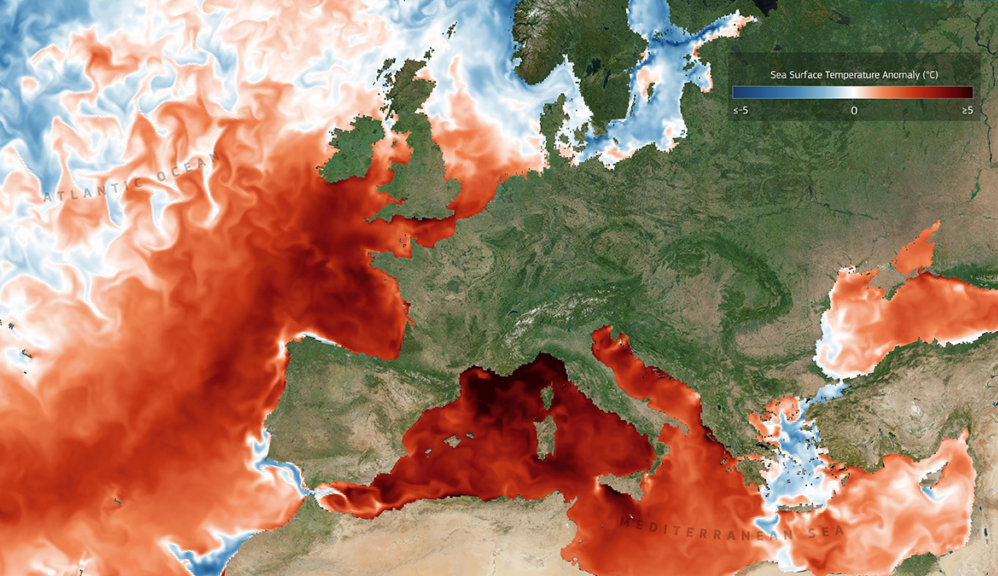
Marine heat waves and extreme ocean acidification events are each damaging on their own. But when both stressors hit simultaneously, their individual effects can be exacerbated.
That threat may be best exemplified by “the Blob” of 2013–2015, during which both a marine heat wave and an ocean acidification extreme event hit the northeastern Pacific. Fisheries were closed, marine mammals were stranded, seabirds died, and sea creatures either changed their distribution or perished.
But our understanding of these compound heat-acidity ocean extreme events is limited, with more research focused on the marine heat wave component than on the acidification aspect.
Gregor and Gruber used 43 years of monthly data (1982–2024) on surface ocean temperatures and acidity to determine when, where, and why compound heat-acidity extreme events have occurred. They defined extreme events as those situations when detrended acidity and temperature exceed their 95th percentiles.
Compound ocean heat-acidity events happen more often than would be expected by chance, the authors found. In the low to midlatitudes, they occur roughly 4 times more often than compared to chance, mostly in places with permanent stratification. In these places, heat waves drive waters to be more acidic. The compound events were least common in the eastern equatorial Pacific and around the poles, where deep waters upwell to the surface. When marine heat waves strike in these upwelling regions, a warm lens (top layer of water) prevents the surfacing of the deep acidic waters, leading to unusually low acidity for the region.
A majority (73%) of compound heat-acidity extreme events in the study period were smaller than 500,000 square kilometers (193,000 square miles, roughly the size of Spain) and lasted for about a month. But a few events, like the Blob in 2015, lasted for more than a year, sometimes with long-lasting consequences.
El Niño and La Niña events are important drivers of these compound events, but the events seldom happen at the weather events’ epicenter in the equatorial Pacific. During El Niño, warmer waters create a lens that prevents upwelling, thus reducing the typical acidity of the region. And during La Niña, cold, deep waters with higher acidity upwell, resulting in only an acidification extreme. However, it is in the neighboring regions where the knock-on effect of this warming or acidity causes compound extremes to occur.
The new findings are in line with several key facets of earlier work and offer more insights into temporal patterns and drivers. (AGU Advances, https://doi.org/10.1029/2025AV002112, 2026)
—Rebecca Dzombak, Science Writer

Citation: Dzombak, R. (2026), Why marine heat waves and acidification strike together, Eos, 107, https://doi.org/10.1029/2026EO260269. Published on 24 August 2026.
Text © 2026. AGU. CC BY-NC-ND 3.0
Except where otherwise noted, images are subject to copyright. Any reuse without express permission from the copyright owner is prohibited.
Source: Science – eos